
Layoffs seem to be everywhere these days. You scroll through feeds, and it’s another round of cuts, another company restructuring. If you're a seasoned manager, losing your role can feel like hitting a wall. And finding new jobs is a really uphill battle, especially with all the talk about flattening organizations and cutting down on management layers.I still believe it's impossible to have many direct reports without sacrificing several aspects of effective leadership.
Anyhow, the change you’re looking for might not be about layoffs. Sometimes, life just changes. Family situations, burnout, wanting something different. You name it and life happens. Over the past decade, I’ve had to move around a bit because of family stuff. With each move came another round of interviews for management roles.
The thing about those interviews is that the higher the role, the fuzzier the questions get. It’s less about how you’d build a system and more about how you’d hold things together when the system breaks. How you’d keep leaders motivated when morale dips. How you'd juggle business needs without burning out your team. How you’d manage underperforming leaders while keeping everyone else engaged. It makes sense, though. When companies trust you with a group, they want to know you won’t steer it off course. They’re hiring you to manage projects as well as uncertainty, conflict, and change.
I’ve been on the other side, too. I have been interviewing managers myself for a while either in a role that I was hiring or some other group. And honestly, it’s really made me rethink the way I approach interviews. You start to notice what clicks, what doesn’t, and how easy it is to get caught up in saying what you think they want to hear instead of just being clear about how you work.
So, I thought I’d share a few thoughts. If you’re preparing for engineering management interviews, whether by choice or circumstance, here’s what’s helped me and what I’ve seen work for others. Let’s start with logistics.
 Engineering manager interview reorg meme
The Funnel Gets Tighter
Engineering management interviews aren't like IC interviews. Maybe, half lie. The initial part is probably pretty much the same but the final isn’t. As a manager, you're evaluated for your skills, how you lead, how you communicate, and how you fit into the organization. And the process itself feels more like a funnel, narrowing down candidates at each stage.
It starts with CV screening. Recruiters skim through a stack of resumes, filtering out anyone who doesn’t tick boxes. Honestly, it’s hard to know what those boxes are without internal information. You might feel like you're a perfect fit for the job, yet you may not even get a recruiter call. The screening is mostly a conversation about logistics and surface-level fit, such as visa, salary, tech stack, and all that, rather than a deep evaluation. Recruiter almost certainly will ask compensation expectation, don’t answer, and ask for their salary band. You don’t need to show your hand. By this point, the pool has already shrunk, and you're down to maybe 5 to 10 candidates. You probably know this drill anyway as you’re doing the same thing for ICs. So, nothing new here.
That’s when the hiring manager steps in. They will take a look at your CV and see if it is a good fit. If they think you might make it, they will ask the recruiter to schedule an interview. They’ll dig deeper, trying to gauge your experience and beyond. They want to know how you think, how you lead, and whether you can navigate the complexities of the role. After that screening interview, the pool usually drops to two or three serious contenders.
You’re pretty much competing about the other candidates. They’re going through the same rounds as you are. By the final stretch, it’s less about being good enough and more about being the best fit for that specific team, in that specific moment. It’s never about pure skill. It’s more on the lines of motivation, leadership style, and even something as subjective as how well your approach aligns with the hiring manager’s expectations can tip the scale.
You can lose the opportunity for countless reasons. Sometimes it's within your control, sometimes it's not. I won’t dive into all the variables, but I will say this subjective experience matters. How you made someone feel in the interview, how clearly you articulated your leadership style, or even how well you connected with the company’s mission can be the difference between a “yes” and a “no.”
 Three engineering managers competing in an interview
Breaking Down the Interview Themes
Now that we’ve covered the logistics, let’s talk about the themes you’ll encounter during an engineering management interview. The process typically revolves around three core areas: technical, leadership and culture. All matter, but how they're evaluated shifts as you move up the ladder.
1. Technical Rounds
Since it's an engineering management interview, there’s usually one or two technical rounds. Depending on the level, you might get asked to code, but honestly, I don't see that happening anymore. With AI tools everywhere, it feels less relevant. Instead, technical rounds tend to focus on three things:
1. Complex Systems
You’ll get asked about either the complex systems you’ve built yourself earlier in your career or the ones your teams have built under your leadership so called technical deep dives. This gets trickier the higher you go because, realistically, you're not the one writing the code or designing the system. You’re not even dictating how things should be built, not because you can't, but because you’ve got talented engineers at staff, senior staff, and principal levels who already excel at it. They don’t need you in the trenches, and frankly, you shouldn’t want to be there.
2. System Design
The other common area is system design. Nothing groundbreaking here. It’s the usual “design X” type of question. That said, engineering managers often get a lighter version of what staff+ engineers face. Nobody expects you to whiteboard a perfect solution under pressure, but you should be able to walk through trade-offs, scalability concerns, and why certain decisions make sense. The difference between how a manager and a staff engineer is treated in these rounds is pretty stark. For managers, it's more about understanding than perfect solutions.
3. Operational Excellence
This round typically revolves around how you keep the lights on while still letting your team move fast. Think production stability, incident response, engineering health, and the guardrails you have in place so one bad deployment doesn’t spiral into a multi-day dumpster fire. It’s a balancing act: if you slow everyone down with heavyweight processes, they’ll resent it. But if you ignore basic safeguards, you’ll be spending your nights putting out fires. So, you need to talk about trade offs as usual.
Interviewers will often ask how you handle critical incidents, from the initial triage to the postmortem. Nevertheless, operational excellence isn’t just about firefighting as you know. They’ll want to see how you approach things like CI/CD pipelines, canary or phased releases, and real-time monitoring. If you don’t know enough details around these, you might get caught off guard. You also need to show good understanding of engineering principles.
2. Leadership Rounds
If technical rounds are about proving you understand the craft, leadership rounds are about proving you can steer the ship. Each company is different but expect at least two rounds of leadership interviews. This is where interviewers try to figure out how you lead, influence, and drive impact. It’s more about people, teams, and the organization as a whole than just projects.
There’s no single format for leadership interviews, but the themes are usually consistent. Expect conversations around how you build, maintain, and grow high-performing teams while aligning them with broader company goals. Here’s what typically comes up:
1. Performance Management
How do you handle performance across the board? It’s easy to talk about motivating high performers, but what about the ones struggling? You are expected to identify root causes for bad performance. People want to see if you can analyze skill gaps, lack of clarity, or personal issues. How do you approach that conversation? How do you decide when to coach, when to support, and when to part ways?
For instance, one IC I worked with was struggling under a new manager, even though he had been absolutely smashing it with his previous one. After two months, I had to intervene and moved him to another manager. He went right back to smashing it. You need to tell stories like that but in more detail.
2. Influence Without Authority
Leading your team is only part of the job. No team works in isolation. You’re working with other managers, product leads, and leadership. How do you build alignment when you don’t have direct control? Maybe you’ve had to convince the product to shift priorities or push another engineering group to adopt a shared standard.
It’s never just about the idea itself. It’s more or less about your approach. People want to see how you handle the conversation, find common ground, and move things forward without burning bridges. That’s what they really want to hear.
3. Organizational Design
As teams grow, shrink, or priorities shift, org structure can make or break good execution. How do you spot when a team is stretched too thin? When do you split a team, create a new role, or even reduce scope without making it feel like a demotion? How do you move investment from one area to another without bruising egos or tanking morale?
You’re asked this question because you are expected to recognize friction points early and make changes without leaving collateral damage behind.
4. Growing Leaders
Depending on the role you're interviewing for, this can take different forms. But at its core, it’s about growing people. You’re expected to develop talent at all levels. ICs to tech leads, tech leads to managers, and managers to managers of managers. How do you pave the way for their growth while keeping everything aligned with organizational and business goals?
For almost any management promotion, there needs to be a strong business reason behind it. Plenty of managers are great at mentoring engineers. What about developing future leaders? How do you prepare someone for their first tech lead role? How do you handle it when someone thinks they’re ready for a promotion but clearly isn’t? How do you identify skill gaps? How do you give constructive feedback for very senior people?
Your interviewer is not looking for frameworks here. You need to have real stories. You need to show times when you actually made it happen.
5. Handling Tough Conversations
Tough conversations come with the job. You’ll get asked how you’ve handled them. Layoffs, demotions, conflicts, even full blown fights. Whether it’s delivering tough feedback, letting someone go, or pushing back on unrealistic expectations from leadership, your approach matters. How you navigate these conflicts says a lot about your leadership style than any project you’ve shipped.
And it’s never black and white. In management, we make decisions with a lot of ambiguity. Like it or not, we represent the business. For the people around you, you are the business. You can’t just say, “Leadership decided this.” You have to own it. That’s the job. It’s about delivering the right message while keeping empathy at the center.
That’s why interviewers want more than a story. They want to know how you handled those moments: what you said, how you made the call, and, most importantly, what you learned from it. It’s less about the outcome and more about your approach and how you’ve grown from past experiences.
6. Setting Vision and Keeping Focus
Companies expect engineering leaders to build a technical vision. They want to know if you can translate high-level company goals into something actionable for your team. Can you ensure day-to-day work actually drives business outcomes? Because the higher you go, the more critical focus becomes.
Interviewers are looking for clues beyond setting goals. They want to know how you navigate the messiness that comes with them. How do you set priorities and plan when everything feels urgent? How do you measure success when business goals keep shifting? What do you do when things inevitably go sideways?
It’s never about just execution. One quarter, leadership might ask you to accelerate; the next, it’s all about slowing down and reassessing. How do you keep your team focused while adjusting the pace? What’s tactical, what’s strategic, and how do you tie them together without losing sight of what actually matters?
Ultimately, they’re testing if you can lead without a perfect roadmap. Software business has constant change, tough trade-offs. They need to know you have the ability to keep your team moving in the right direction.
7. Hiring
Interviewers want to know how you approach hiring: where your talent comes from, how you assess fit, and how you make sure you're hiring people who’ll thrive in your environment. Strong leaders build their own pipelines and have their talent sourcing journey, and the takeaway is simple: good people aren’t always looking. You have to go find them.
Once you’ve got candidates, how do you assess them? It’s easy to focus on technical skills, but if you’re not evaluating how they’ll fit into your team’s way of working, you’re setting everyone up for failure. You need to have your red flags and make it part of how you hire.
Great teams work because they have the right skills, operational experience, mindsets, and personalities to balance each other out. How do you ensure new hires add to that, rather than disrupt it? This is where hiring harmony comes in. The hire has to work for the team you are building as well as the one you have today.
At the end of the day, interviewers want to know if you have a solid grasp on expanding the team. They’re asking if you can build a team that works technically, culturally, and sustainably.
3. Culture Rounds
If leadership rounds focus on how you lead, culture rounds focus on how you work with others while leading. It’s less about individual results and more about how you navigate the environment, shape team dynamics, and uphold company values.
There’s no standard playbook here. It’s about whether you strengthen the company’s culture or silently undermine it. Interviewers are typically looking to answers if you can lead without breaking what already works and push for change without total disruption. Here are a few things I see come up a lot.
1. Promoting learning and growth
If you have been in the leadership, you know saying and making it happen are two different things. Promoting right behavior happens when people see how you handle when things don’t go as planned. Interviewers are interested in how you promote learning and growth while facing different challenges.
That’s where incidents come in. They’re good culture tests. They happen often enough to do the right or wrong things. You can literally get everyone to do better by promoting learnings in incidents, making every incident improve the system and understanding. So, if you are doing the right things, then use incidents as your example. I did many times, it almost always worked.
Interviewers are checking if you lead those conversations. Do you create a space where people can talk about mistakes without fear? Can you drive change without killing morale?
2. Company Culture
This is where you are tested if you have company values or shown them before. You need to show you align with how this company operates.If the organization values collaborative decision-making, share how you’ve engaged a team or gathered input to achieve results. Emphasize core engineering principles, but ensure they connect to the company’s values.
To prepare, read the company's values if they are publicly shared. Check employee reviews, watch how they celebrate, and observe how their leaders speak. Then, when you answer culture-based questions, tie your experiences back to these values. You’ll show that you understand their values and can work within their actual day-to-day environment. I’ve been eliminated, rightfully so, a few times because of this. I didn’t study the company, and I didn’t care much because I was window shopping. It shows itself quite easily, so make sure you have some enthusiasm about the company’s values.
3. Communication
Interviewers want to see how you communicate, how you listen, and how you make things happen. They’re looking for real-life examples that show you get things done. Remember they will judge the way you handle the interview itself. So, don’t throw anyone under the bus ever regardless of the situation. Don’t do this in general, too. I’m telling it to myself.
One approach I’ve found effective is highlighting your listening skills. Great leaders know how to listen, and sharing stories where you truly heard others pays off every time. Another critical piece is demonstrating how you build consensus or how you disagree and still commit to a decision. Show them you can transform obstacles into opportunities by framing the problem in a way that moves everyone forward. You want to demonstrate you don’t leave anyone behind.
4. Trust
There’s no trust round overall but everyone wants to trust you in the end. If you’re stretching your answers just to sound like a culture fit, you’ve already lost. Be real. Be humble. Don’t exaggerate.
The second part of trust is building it. People want to see if you can reliably build a foundation of trust, especially in engineering contexts. You already know the smallest actions can either strengthen or erode the trust that underpins any great culture.
Don’t Be a Red Flag
In a leadership interview, you need to show that you’re not the type of manager people quietly escape from. Red flags don’t always scream. With experience, you get to notice them. They usually creep in through how people talk about decisions, teams, and problem-solving. Personally, I’d rather see someone with a skill gap than someone waving a red flag. Skills can be learned, but red flags are harder to change and, sometimes, nearly impossible to coach. It’s not a risk worth taking. Assuming you don’t have red flags, here’s how to avoid sounding like a red flag.
1. Dictatorship
I once interviewed a manager who talked like he had everything figured out. It felt like his whole approach was, “I told the team what to do, and we moved forward.” No mention of collaboration. No acknowledgment of uncertainty. Just pure top-down decision-making. It didn’t take long for me to realize that this dude wasn’t leading, he was dictating.
Compare that to another manager I spoke with who faced a production outage caused by a deployment issue. Instead of pretending she had the fix, she said, “I pulled in the oncall engineer and the person who authored the change. We ran a triage session, reverted the change, and added a unit test case to avoid the same issue.”
That’s leadership. She brought the right people to the table, focused on the problem, solved it, and got back to normal business. You want an enabler who lets their team run on their own. Not the opposite!
2. Micromanaging
There was this one manager who couldn’t stop talking about how hands-on he was. He claimed it was about maintaining high standards, but the more we talked, the clearer it became. He was just old school micromanaging. “I stay close to every project to make sure nothing slips.”
Translation? You don’t trust your team to execute without constant oversight.
Compare that to another manager I interviewed who said, “On a recent project, we had weekly check-ins where the team surfaced blockers. One engineer flagged a delay due to external dependencies. We escalated it together, and they handled the rest.” You want to see leaders stepping in when necessary but letting the team execute without intervention. It’s about creating clarity, stepping back, and being available when needed.
3. Avoidance
When a manager avoids hard conversations, that’s probably a deal breaker for every hiring manager. You want someone to handle competition, underperformance, collaboration and so on. In a past interview, the interviewee bragged about how they “trusted the team to figure things out among themselves.” It sounded nice until I pressed for an example of how they handled underperformance. He couldn’t name one. That’s not trust. That’s avoidance.
Contrast that with a leader who told me about an engineer on their team consistently missing project milestones. Instead of ignoring it, she said, “In our 1:1, I asked what was going on. Turns out, he was splitting time across two projects, and the context switch was too much for him. We sat down, reprioritized, and left him with one project. His delivery immediately improved.”
That’s leadership. You spot issues, address them early, and support improvement.
4. Ignoring Growth
I once asked a manager how they supported career growth on their team. He replied, “I make sure everyone has challenging projects.” That’s not growth. That’s work. It was obvious he saw delivery as the only metric that mattered, with zero thought given to skill-building or long-term goals.
Now, compare that to another manager who told me about a senior engineer on their team who wanted to move into a staff engineer role. “He was stuck in feature work,” he explained. “So, we carved out time for him to lead a tech design for an upcoming platform refactor. We paired him with a staff engineer for mentorship, gave him visibility in cross-team design review meetings, and had him present his work in our monthly engineering forum. Six months later, he was leading cross-functional initiatives and taking ownership of technical strategy.” That’s how you grow people: deliberate, structured support. You can’t just pile on more tasks and call it progress. You want to push your people towards unknown territory as it helps people to grow faster.
5. WLB
A clear red flag is when a manager treats overwork like dedication. I once interviewed someone who proudly said, “I’m always available, even on weekends,” as if grinding 24/7 proved his leadership. But all it really proved was that they didn’t know how to set boundaries for both himself or his team. If a manager can’t protect his own time, what are the chances he’ll protect yours?
Compare that to another manager who told me about a project that slipped. “We didn’t ask the team to work late,” he said. “We reprioritized, communicated the new deadline, and documented lessons learned for future planning.” No heroics, no late-night pings. It’s just clear leadership that keeps things moving without burning people out. That’s what you want to hear: someone who knows how to manage work.
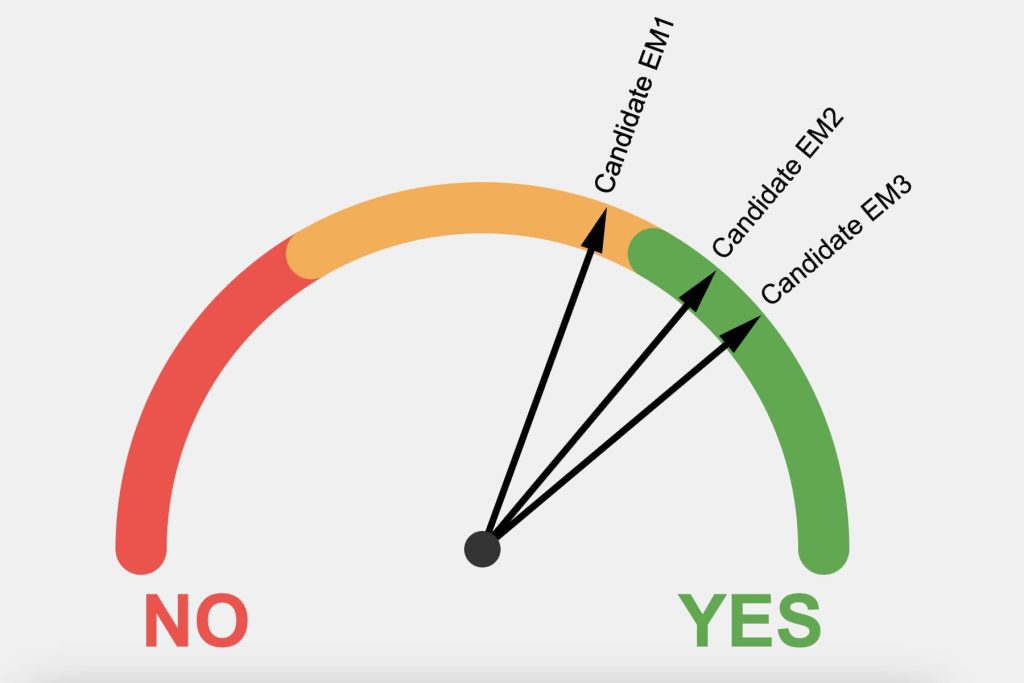 Engineering manager candidate evaluation gauge
Interviews are Subjective
As much as I’d love to say leadership interviews are objective, they’re not. You can ace every round, impress everyone in the loop, and still get blocked by someone who didn’t even bother to read your résumé. I’ve seen it happen more times than I can count. Please, don’t be that person.
Then there’s the other type: the one hiring for a leadership role without possessing any real leadership skills themselves. Sometimes they are just downright terrible. It’s frustrating, but it’s also reality. Maybe they landed the position for reasons you’ll never know. Honestly, you shouldn’t care. That’s not your problem, so don’t waste energy dwelling on it. Leadership hiring isn’t always about merit; it’s often about timing, opportunity, and who gets the right break. You can cry about it, or you can move on.
Here’s my rule of thumb: if you don’t think you’d click with your hiring manager, don’t bother finishing the rest of the interviews. It’s not worth the headache. That relationship will make or break your experience, no matter how great the company seems on paper.
And one more thing. You probably know that already. You’re not just interviewing for a job. You’re interviewing for the environment where you’ll spend most of your waking hours. Keep that in mind.