
When I wrote this piece on setting goals, I focused on the practical side: clarity, motivation, breaking down complexity. But here’s the thing. Even the clearest goal doesn't mean much if you don’t understand who you are. It’s beyond MBTI kind of stuff. I’m referring to a closer look at yourself.
That’s where the Johari Window comes in. It’s a model from the 1950s that still slaps today. Basically, it splits your self-awareness into four boxes:
- Open Area: What you and others know about you.
- Blind Spot: What others know about you that you don’t.
- Hidden Area: What you know but keep to yourself.
- Unknown Area: What no one knows about you — yet.
You might be wondering, “Why the hell does this matter for goals?” Let me explain.
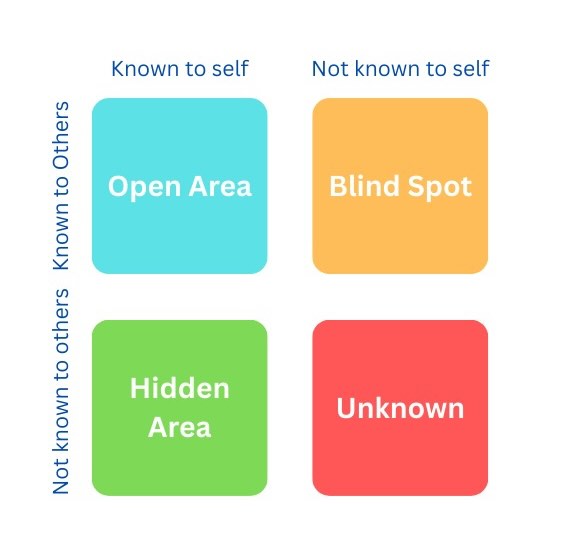 Johari Window
When Self-Awareness Meets Goal Setting
1. Open Area
This is your comfort zone. It’s your go-to zone when setting goals. You already know these strengths or weaknesses. People have probably confirmed them.
Example: I knew I wanted to write more, and I’ve always been decent at expressing ideas. Hence, 20 blog posts a year. Measurable. Clear. Public.
Cool. But don’t stop there.
2. Blind Spot
This is what you miss but guess what everyone else sees. This one stings. There are things you’re not great at. Things you don’t even realize but your colleagues, friends, or teams do.
If someone tells you, “Hey, you interrupt a lot,” and your first reaction is “No, I don’t,” that’s your cue. You’ve just stepped into your Blind Spot.
Goal tip: Ask for feedback. Not the sugar-coated “you’re doing great” type. Constructive feedback. Then use that to shape better, more uncomfortable goals.
3. Hidden Area
These are the stuff you bury. These are things you know about yourself but don’t talk about. Maybe it’s a fear. Maybe it’s ambition you think people will mock. Maybe it’s a creative side you haven’t shared.
I’ll admit it: For the longest time, I didn’t talk about wanting to work on making video content. I started some but I’m really shying away. Not because I didn’t care but because it didn’t “fit.”.
Goal tip: Turn your secrets into experiments. What if your hidden side is where your best work lives?
4. Unknown Area
This is an uncharted territory for you or anyone else. No one knows this stuff including yourself. You find it only by doing. That’s why some goals should feel weird, slightly ridiculous, maybe even “not you.”
I once asked someone on my team to run a workshop. They were terrified. Turns out, they're insanely good communicators. They just hadn’t discovered that part yet.
Goal tip: Set one “wtf” goal per year. Something that feels out of character. Just to see what you find.
So, What Now?
Here’s how I’d mix Johari into your next goal-setting sprint:
| Johari Quadrant | Example Goal |
|---|---|
| Open Area | Write 2 blog posts a month on engineering leadership. |
| Blind Spot | Ask 3 peers what I can improve in meetings and act on it. |
| Hidden Area | Share a creative side project publicly. |
| Unknown Area | Try something I’ve never done before. Host a podcast, take an acting class, whatever. |
This framework makes goal-setting more than an exercise in planning. It makes it a little more honest.
We like to believe goals come from clarity. Most of the time, they come from the version of ourselves we already understand. That is the comfortable part. The harder work is noticing what sits outside that view: the strengths other people see, the weaknesses we avoid, and the possibilities we have not yet considered.
The Johari Window will not tell you who to become. It simply makes your reflection less incomplete. And perhaps that is enough to set goals that are not limited by the person you already know.