
I’ve had all kinds of bosses over the years. Some of them were visionaries. Some others were quiet geniuses. One thing I’ve learned is that if you want to survive and maybe even thrive, you need to understand what they want, what they need, and how they operate. In other words, learn to manage your managers.
But before you can do that, it helps to know what kinds of leadership styles are out there. Not every leader fits neatly into a box. It’s a bit like the MBTI. Nobody fits their type perfectly, but it still gives you a useful snapshot of their overall personality. Psychologists might not be happy with what I just said, but well, it works for most part. Some leaders build, some inspire, and some just keep the engine running.
Here are a few archetypes. Once we go through them, you’ll start to see where your boss fits in. They’re the types that keep showing up in every organization, one way or another.
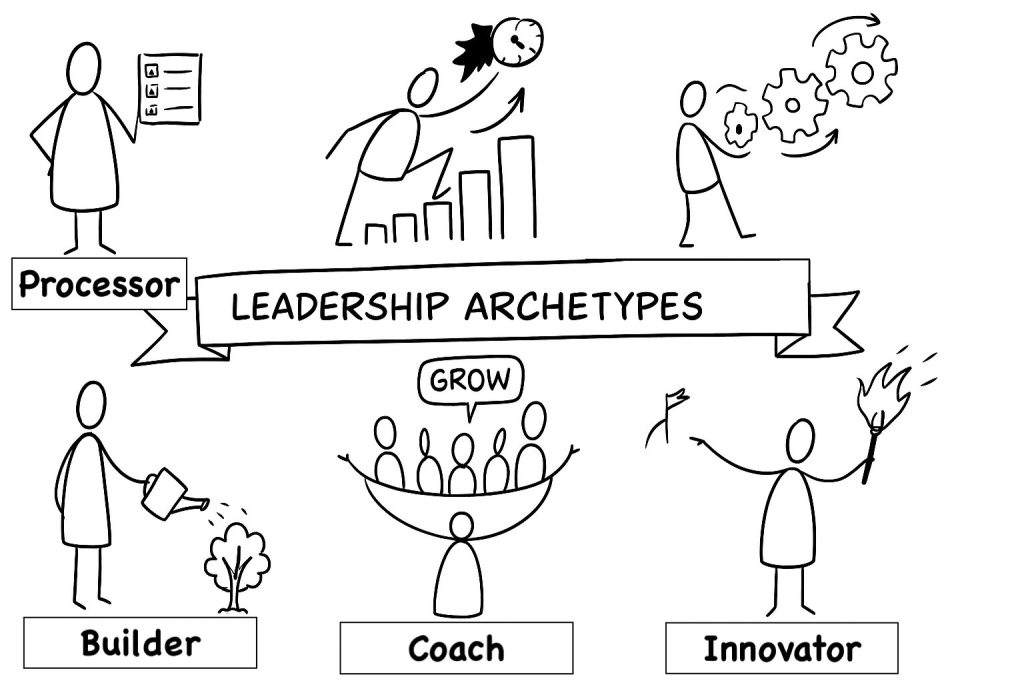 Leadership Archetypes
The Innovator
The Coach
The Builder
The Processor
Leadership Archetypes
The Innovator
The Coach
The Builder
The Processor
The Strategist
You’ve probably worked with one before. These are the kinds of managers who focus on the big picture. Be it vision, be it strategy. They always have a roadmap or a framework. They aren’t really detail oriented. They want you to handle a lot of ambiguity. Asking them for details is useless for both your and their time.
Strategists are the long-game thinkers. They can tell you where the team should be in three years but might forget the release tomorrow. They’re great when you need direction, but not always the person you want solving a production issue at 3 A.M.
They’ll move teams around, restructure priorities, and redesign the org chart. They’re generally calm when others panic. The trick with a strategist is to speak in outcomes, not details. They don’t want to know how many commits you pushed; they want to know how what you did moves the strategy forward.
Change-Catalyst
These are the ones who show up when everything’s on fire and somehow, they love it. Give them a messy project, a broken process, or a team that’s lost motivation, and they come alive. These people will question why things are done a certain way before you’ve even finished explaining. Sometimes it’s inspiring, sometimes it’s exhausting. But if your team’s stuck, they’re exactly who you want in charge.
They replace old systems, challenge assumptions, and push people out of their comfort zones. Unfortunately, it’s often faster than anyone’s ready for. They’ll rebrand your product, rewrite your strategy, and rebuild your team.
Working for a change-catalyst, expect turbulence. Their energy is contagious, but so is their impatience. They’re not big on “that’s how we’ve always done it.” The best way to deal with them? Match their curiosity and focus on momentum. Don’t defend the old way. Help build the new one.
The Transactor
These dealmakers know everyone, and everyone knows them. If the strategist draws the roadmap, the translator builds the roads by talking to the right people, at the right time, in the right tone.
They’re the ones who somehow convince two rival teams to work together, land a critical partnership, or pull in extra funding just by “having a chat.” Their power lies in their network and timing. They might not write a single line of code, but they’ll get you the resources to unblock your project.
Transactors thrive on opportunity. They can sense when a door is half open and slip through before anyone else notices. Working for one means staying adaptable. They’ll pivot priorities mid-week because they just came out of a call with “someone important.” Don’t fight it. Just keep your goals tied to outcomes, and communicate often. When they win, everyone wins. Just be ready to sprint when the next deal lands.
The Builder
Builders are the ones who get a thrill out of starting from zero. Give them a blank page, and they’ll sketch the product, the architecture, and maybe even the company logo before lunch. They’re obsessed with creating things that didn’t exist yesterday.
You’ll usually find them in startups or internal innovation teams. I have been to a few. Some of my bosses back there were builders. They don’t want to optimize; they want to build. And once it’s running smoothly, they’ll probably get bored and move on to the next challenge. Builders see possibility everywhere. They can rally a small group of people around an idea and somehow convince them to work weekends because “we’re close.” They move fast, take risks, and love problems.
Under a builder, prepare for chaos, but the good kind. They’ll push you to do things you didn’t think you could. Just know that stability isn’t their comfort zone. When they start saying, “I think we’re done here”, it simply means yet another project or feature starting. They love pace. So, you need to keep your rhythm to them.
The Innovator
Innovators are the ones who can’t stop tinkering. You will see them even touching things even if they work perfectly fine. They’re the reason the plan suddenly includes a “small experiment” that somehow becomes a three-month project.
Their brain runs on curiosity. They’ll spot patterns no one else sees and come up with ideas that sound borderline impossible until six months later when the industry starts copying them. They thrive on creative tension, on pushing boundaries just far enough to make everyone uncomfortable.
They’ll question everything, from the product roadmap to the color of the login button. But here’s the thing: they’re usually right about the direction. The problem is just terrible timing. Your best move with an innovator is to ground the vision. Help translate their ideas into something actionable before they sprint off to the next shiny thing. Don’t say no. Say not at the moment.
The Processor
Every team needs one. This is the person who brings order to the chaos. While everyone else is chasing ideas, the Processor is quietly building systems that keep the whole thing from collapsing. They’re obsessed with structure, predictability, and process. They’ll turn a vague “we should probably fix this” into a Jira workflow, a checklist, and a recurring meeting. They think in frameworks, dependencies, and flowcharts. They like processes and order.
Processors aren’t flashy, but they’re the reason deadlines get met and production doesn’t burn down every weekend. They’re the backbone of scaling. These are the people who make the machine actually run.
Under a processor, expect rigor. They’ll ask for documentation, for data, for proof that what you’re doing fits the system. Don’t mistake it for rigidity. It’s how they keep things sustainable. The best way to work with them? Respect the process, even if it feels slow. It’s what lets everyone else move faster later.
The Coach
You’ll know when you’re working for one. They ask more questions than they give orders. They care less about what you delivered this week and more about how you’re growing while doing it. Coaches are people-first leaders. They notice when you’re burned out, when you’re stuck, when you’re quietly doubting yourself. Instead of fixing the problem for you, they’ll nudge you toward the answer. It’s slower, but it sticks.
They’re the ones who celebrate small wins, give feedback that actually helps, and somehow make one-on-ones feel like therapy sessions. They believe in potential more than performance. It shows the loyalty they inspire.
With a coach, be honest. They can tell when you’re pretending things are fine. Don’t expect them to micromanage. They want to see you take ownership. The more you invest in learning, the more they’ll invest in you.
The Communicator
If leadership had a voice, it would sound like them. These people can turn a vague idea into something everyone suddenly understands and actually wants to rally behind. They’re storytellers at heart. They make strategy sound exciting, connect dots across teams, and can calm a room just by explaining what’s happening. When things go wrong, they’re the bridge between chaos and clarity. You’ve probably seen them in action during an all-hands or a crisis meeting. This is the person who somehow makes everyone feel like, “Okay, we’ve got this.”
Communicators translate between engineers and executives, between vision and execution, between people who would otherwise never understand each other. With a communicator, keep them in the loop. They thrive on context. They want the full picture so they can tell the right story. And if you ever need your work to be noticed, they’re the best ally you can have. They’ll make sure the right people hear about it.
All in All
It’s hard to put anyone into one box. Most leaders are a mix, a strategist in planning, a builder in execution, a coach on good days, and a processor when everything catches fire. The point isn’t to label people; it’s to understand them. Once you see how they operate, you can work with them better or lead them better. And maybe, if you’re honest, you’ll see pieces of yourself in more than one archetype too.