
I’ve seen this happen over and over. A successful engineer steps into management. They are eager to build great teams and support their people. They know some of the leaders before didn't do that. They embrace servant leadership, convinced it’s the key to success. But then reality kicks in. The higher you go, the more you realize leadership goes beyond serving your team. It becomes more and more about delivering results. Suddenly, the ideals they once held feel… naïve.
I’ve been there. The question is: how do you lead without losing yourself to business metrics? In this post, I’ll break down why servant leadership alone isn’t enough, the leadership triangle, how executives think, and how to balance it all effectively.
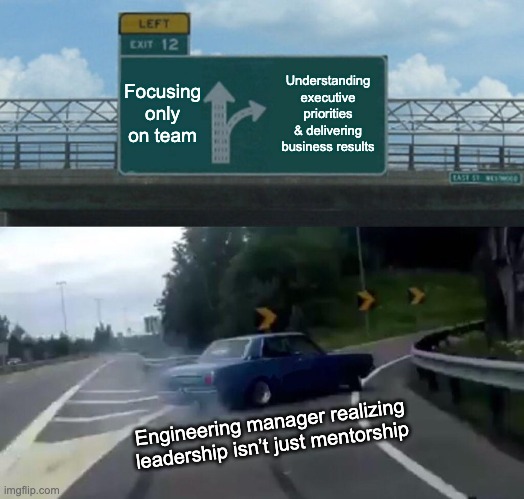 Servant leadership vs. delivering results meme
The Reality of Leadership Styles
Leadership isn’t about picking a style and sticking to it. As you might have seen already, it simply doesn’t work. Early on, as most of us have done, we focus on mentorship and team well-being — servant leadership, coaching, and helping people grow. But as we move up, the focus shifts. You need to adjust your approach to strategy rather than focusing solely on people. Metrics, revenue, and business objectives take priority.
And you know what? This shift isn’t optional. Businesses run on results. At higher levels, people need to make tough calls that don’t always favor individual needs. You represent the business. The job is to align team motivation with business goals. At the same time, you need to be while credible to both sides.
All you can do is adapt your approach, but that’s not as easy as it sounds. You need to have that poker face. A lot. Some situations require a hands-off approach; others demand direct intervention. So why can’t we do that while practicing servant leadership?
Why Servant Leadership Alone Isn’t Enough
I used to believe servant leadership was the key to everything. Support your team, remove blockers, and success would follow. And for a while, it worked. At least, that's what I convinced myself with. From my point of view, my teams were engaged, motivated, and productive. But then I realized something: while employees appreciated it, executives weren’t always convinced. The more you listen, the more you understand they focus on efficiency, execution, and measurable outcomes. It makes sense. This isn't charity. You're supposed to deliver.
At higher levels, leadership isn’t just about mentorship and coaching. You need to make hard calls, drive strategy, and sometimes shield your team from pressures above. If all you do is serve, you risk becoming ineffective. Leadership has to be fluid. You have to know when to step in, when to step back, and when to push forward. Servant leadership is valuable, but it’s not enough on its own. Sooner or later, you’ll face the leadership triangle just like CAP theorem.
The Leadership Triangle
Leadership is a constant balancing act. You’re not just responsible for your team. You need to juggle different forces that often pull in opposite directions. I think of it like the Leadership Triangle, which, much like the CAP theorem, forces trade-offs between three key areas.
- Career Growth – Helping people develop their skills, take on challenges, and move forward in their careers.
- Tech Debt – Keeping the codebase clean, scalable, and maintainable instead of letting quick fixes pile up.
- Customer Needs – Delivering features fast, meeting business goals, and staying competitive.
Sounds all good. What’s the deal? Well, you can’t optimize for all three at once. Just like in CAP theorem (where a distributed system can only guarantee two out of Consistency, Availability, and Partition Tolerance), leadership means making trade-offs. Prioritizing fast delivery often increases tech debt. Focusing on tech quality can slow down feature releases. Investing in career growth sometimes conflicts with short-term business goals.
So, you need to live with these conflicts. Make them part of your execution such as engineering health. Sometimes you need to push for engineering excellence or deliver quickly. Other times, you need to step back and support individual growth. You also need to keep sight of the bigger picture while doing all together. Talking to executives actually helps here to set the perspective.
Understanding Executives
Talking to enough executives in different companies, I noticed common patterns in how they think and operate. Their world is a different game. Their decisions have more elements than aren’t engineering quality or team well-being. They need to evaluate long-term impact, business positioning, strategic investments and sometimes getting along with someone or company. Here’s what stands out:
- Hard Things About Hard Things – Executives juggle high-stakes decisions daily. They often have back-to-back 12+ meetings. They don’t have time for deep dives into every issue, so their focus is on what moves the needle. If you bring up a problem, they expect a clear path forward, not just the problem itself.
- People Do What You Inspect, Not What You Expect – Strategy isn’t just about setting a vision; it’s about making sure execution happens. Your leader might step in where it matters to course-correct, but they don’t want to micromanage every detail. If something isn’t being tracked or reinforced, it won’t get done.
- Command Without Control – The best leaders set the direction and explain what matters, then let the team decide how to execute. People should be able to move without waiting for instructions at every step.
- Engineering Should Do Its Work – Engineering is an investment, and like any investment, it needs to show returns. That return is beyond shipping features. You need to think of building long-term capabilities, ensuring the company’s competitive edge, and maintaining a balance between innovation and execution.
Executives think in terms of investments. Every hire, every project, and every strategic shift has an associated cost. The key question is always: What do we get in return? If you hire five engineers today, will their work still be relevant in two years? If you refactor the codebase, will it make future work more efficient, or is it just a one-time cleanup? They aren’t looking for perfect technical solutions. They’re often looking for smart, sustainable bets.
This is why speaking their language matters. If you frame engineering decisions in terms of long-term value, risk mitigation, and competitive advantage, you’ll get buy-in. If you talk only about code quality and engineering conventions, you’ll lose them.
Managing Up and Down
Well, you might have realized already but you need to care about both managing up and down. When I first moved into management, I thought my job was all about supporting my team. Often thought, it was mentorship, autonomy, and career growth. And while that’s part of it, I quickly learned that if I wasn’t also managing expectations upward, securing resources, and aligning with business goals. Otherwise, my team’s success would hit a ceiling.
Managing Down (Leading Your Team)
Leading a team isn’t about micromanaging or being everyone’s best friend. It’s about giving people the space to grow while making sure they’re driving impact.
- Career Growth Without Babysitting – Support professional development, but don’t hold hands. Give guidance, but let people take ownership.
- Autonomy With Accountability – Trust your team, but set clear expectations. Freedom without accountability leads to chaos. And you need to build trust within your team, too.
- Align Work With the Bigger Picture – People stay motivated when they see how their work matters. Connect their efforts to company goals.
Managing Up (Influencing Senior Leadership)
If your team does great work, but leadership doesn’t see the value, you’ll struggle to get buy-in for hiring, promotions, or resources. Managing up isn’t about politics. You need to make sure your team’s impact is recognized.
-
Talk Business, Not Just Tech – Communicate through data, results, and business impact. Engineers care about elegant code; executives care about revenue, efficiency, and risk.
-
Frame Problems in Business Terms –Instead of saying, “We need to refactor this system,” frame it with measurable impact:
- Reduce downtime by X%, minimizing revenue loss from outages.
- Lower maintenance costs by Y%, freeing up engineering hours for new features.
- Increase deployment speed by Z%, shortening time-to-market for critical updates.
-
Use Wins to Push for More – When your team delivers, use that momentum to ask for better tools, more budget, or additional hires.
-
Choose Battles Wisely – Escalate only when necessary, and always bring solutions, not just complaints. If everything is urgent, nothing is.
A Balanced Approach
No single management style works in every situation. Great leaders adjust based on team dynamics and business needs and they have several good traits.
Empathy and empowerment matter, but without execution and clear communication, they won’t drive results. Leadership is about balancing three things: people, process, and profit.
- People – Support career growth, but expect accountability. Set goals.
- Process – Keep execution smooth without over-engineering.
- Profit – Align technical work with business goals.
A flexible approach is the only way to bridge the gap between teams and executives. Get this right, and both succeed.