
A few years ago, my father decided to build a house in the village. On the surface, it was easy to like the idea. A quiet place. A porch. A garden. Somewhere to disappear for a while. Perhaps, a retirement home one day. My sisters and I got excited quickly. We talked about how the house should look, what each room should feel like, what we wanted from the garden, how the porch should open into the rest of the space.
We were planning the visible thing. My father was dealing with the actual system behind it: budget, contractors, electricians, sequencing, materials, and delays. Each came with its own constraints, trade-offs, and opinions. Small compromises started to pile up. In the end, the exceptions defined the outcome.
The house did get built. Later than we wanted. Not quite like we imagined. And nobody involved was fully satisfied.
A roadmap fails in the same way. Teams focus on the visible plan because that is the part they can point at. Unfortunately, the real outcome depends on what’s beneath the surface. It’s in the structure of ownership, dependencies, constraints, and negotiation. The roadmap is an artifact the system produces. What matters is the system itself.
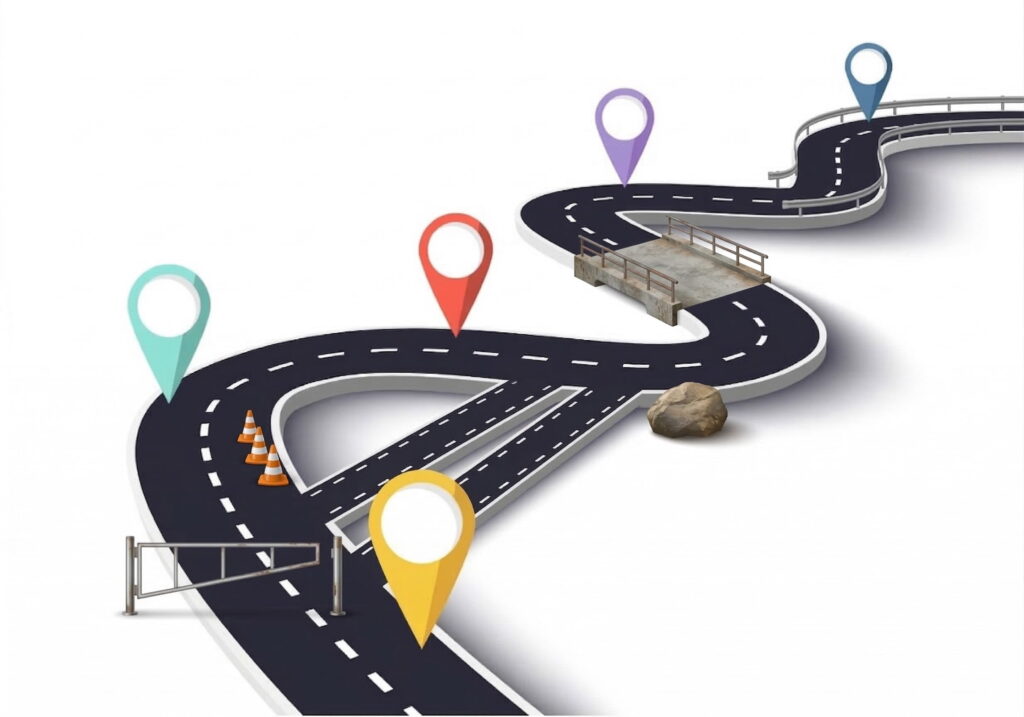 Roadmap shaped by structural constraints
What the Plan Hides
I think treating a roadmap as a ranked list of items with dates is a mistake. It has to be a negotiated expression of constrained capacity. The roadmap is the artifact people can see. Nonetheless, the real structure hides somewhere deep down as it was in our house project.
This is also why “we need better prioritization” is usually the wrong diagnosis. Better scoring does not fix split authority. If sales can promise dates, leadership can override without consulting, platform can block without a shared forum, and engineering cannot pause work for reliability without asking permission, then people are shaping the roadmap somewhere else. What looks like a prioritization issue is usually an authority issue first.
PM and EM as the Translation Layer
PMs and EMs sit in the awkward middle between visibility and reality. Product folks carry the value case. They frame the problem, bring user context, and explain the business reason why something matters now. Engineering folks carry execution reality. We bring sequencing, feasibility, system constraints, architectural consequences, and operational risk. There is shared space between the two, but we shouldn’t turn that into a shared vagueness.
I like technical PMs. Nevertheless, when a PM starts dictating implementation, engineering won’t hear partnership. It will feel like a control. On the flip side, if engineering disappears into technical abstraction, the product does not see stewardship. They will interpret that as delay. Both sides start compensating. PMs push harder because trust has dropped. EMs withhold detail because they feel managed rather than consulted. They might be seemingly polite but the relationship can become adversarial.
That is the point where roadmap work gets distorted. The WHAT versus HOW boundary matters. It is a trust boundary. Product should be able to define the problem, the user impact, and the trade-off worth making. Engineering should be able to shape the implementation to fit the system that actually exists. The negotiation is not whether one side wins. It is whether scope can move without intent collapsing, and whether technical reality can be surfaced without sounding like resistance.
This is why there should never be two separate roadmaps. That is not a healthy specialization. It is usually a sign that the negotiation already failed. The contradiction still exists, only now it has been hidden in two documents instead of resolved in one conversation. And when that happens, developers end up absorbing the mismatch in the middle, expected to satisfy business pressure, technical reality, and deadline expectations at the same time.
Decision Rights Before Prioritization
Before teams debate what matters, they need to decide who gets to decide what. Without that, prioritization quickly turns into disguised politics. If you look at the spreadsheet, it may still look objective, The scoring may still look rational. But underneath it, people are negotiating power. This is why I find many roadmap conversations shallow. Instead of ranking items, they should start with decision rights. Before you prioritize, you need a constitution.
The first boundary is date commitments versus delivery forecasts. These are not the same thing. Teams get into trouble when they pretend they are. An estimation is an informed range based on what is currently known. A commitment is a promise with external consequences attached to it. It changes expectations and perspectives. It changes commercial behavior. It changes what failure now means. If the same person can casually convert a forecast into a commitment, planning becomes fiction. The team is no longer working from delivery reality. It is working backward from a promise somebody else already made.
The second boundary is scope ownership versus implementation ownership. Product should be able to define the problem, the user outcome, and why the work matters now. Engineering should be able to reshape the implementation so that it fits technical reality, system constraints, and the actual cost of change. The negotiation point sits in the middle. Scope can move. Shape can change. Sequences can change. But intent should remain intact. A healthy system makes the boundary explicit so that both sides can negotiate without stepping on each other’s authority.
The third boundary is reliability exceptions. If the mainline is broken, if incident patterns show systemic instability, or if the cost of ignoring technical risk is compounding quietly, engineering should not need permission to stop and repair the system. That should not be treated as an optional detour from the real roadmap. It is part of maintaining the conditions that make any roadmap possible in the first place. A team that has to argue its way into fixing a broken build, a fragile deployment path, or a recurring operational failure is already operating inside a broken process.
The fourth boundary is dependency and upgrade authority. Every organization eventually hits work that is nobody’s favorite but everybody’s problem. You need to deal with platform upgrades, deprecations, migrations, library upgrades, security patches, infrastructure constraints, and cross-team dependencies. These aren’t sexy from a product point of view. If nobody explicitly owns the authority to force those decisions, the work gets delayed until it becomes urgent, expensive, and politically inconvenient. Then it enters the roadmap not as a deliberate trade-off, but as an emergency. That is one of the clearest signs of a weak system. Necessary work had no legitimate path in. You shouldn’t be waiting until reality removes the choice.
The fifth boundary is leadership overrides. Of course leadership can override. Pretending otherwise sounds naive. But the override needs a price. An explicit one. If leadership changes direction, the displaced work should be named. The owner of the new commitment should be explicit. The narrative presented to the organization should become singular. What poisons a roadmap is not the override itself. It is the hidden override. It is the quiet reordering that leaves old expectations alive, new priorities half-declared, and the delivery team carrying mutually incompatible promises.
This is why I would define decision rights before I talk about prioritization frameworks. Ranking only helps once authority is clear. Until then, the framework is mostly decoration. If decision rights are vague, prioritization will be political even when the spreadsheet looks objective.
What Healthy Partnership Looks Like
Healthy roadmap partnership is quiet, much like good execution. People know who owns what. Constraints surface earlier. Trade-offs get resolved faster. Product, engineering, and leadership are not carrying three different narratives about the same thing.
Good systems feel quiet because less energy is wasted relitigating the same conflict. The PM-EM boundary is clearer. Bad news can travel before it becomes blamed. A dependency risk, reliability concern, or scope problem can be raised while there is still room to respond. That is what healthier planning looks like in practice. It’s not perfect trust, just less friction in getting reality onto the table.
Poor systems feel loud for the opposite reason. The same unresolved tension keeps returning under different names: prioritization, feasibility, alignment, communication. The roadmap says one thing, delivery behavior says another, and the real negotiation happens off to the side. By the time the conflict becomes visible, it usually escalates.
Healthy partnership is the absence of unnecessary drama.
In Summary
Before the next roadmap cycle, answer five questions in writing. Who can commit a date? Who can reshape scope? Who can stop feature work for reliability? Who resolves dependency deadlocks? What happens when leadership overrides? If a team cannot answer those cleanly, it does not have a roadmap problem yet. It has an authority problem. Until that is fixed, every prioritization exercise is mostly cosmetic.