
Engineering health is a term that deserves far more attention than it receives. Sustainable software development is not only about the features we ship or the speed at which we deliver. Every organisation, even the healthiest ones, makes decisions that leave a mark over time. Some turn into technical debt. Others harden into weak processes, awkward handoffs, and fragile ways of working. On their own, these things rarely look serious. Put enough of them together and they start to rot the foundation. That is part of engineering. It comes with growth. Still, if you do not push back on it deliberately, the drag becomes normal. That is what engineering health is about.
For a long time, I understood this too narrowly. I thought engineering health was mostly about the technical side of decay: old systems, lagging dependencies, clunky code, things you could point at and fix. That is part of it, but only part of it. Poor engineering health also wears down the team. Repetitive toil, brittle workflows, and recurring avoidable problems pull attention away from work that actually matters. They slow delivery, lower morale, and make good engineers spend their time fighting nonsense. Engineering health is the ongoing work of keeping systems reliable, secure, and adaptable, while also protecting the team from unnecessary friction.
That is the part that matters most to me now. Engineering health is where we deal with the compounding effect of past decisions before they harden into bigger problems. It is maintenance, improvement, and foresight, but it is also judgment. In this post, I want to look at what engineering health really means, why it matters, and why it's not optional.
 Engineering health concept illustration
Defining Engineering Health
Engineering health is the ongoing work of keeping our software systems operational, reliable, and fit for change. At its core, engineering health accepts that decay is part of the job. Systems age, dependencies evolve, shortcuts pile up, and decisions nobody owns turn into liabilities later. If you leave it alone, these things slow teams down and increase risk. Healthy engineering means pushing back on that drift.
That includes staying ahead of security risks, not just reacting after something goes wrong. It includes fixing things when they break, but also improving systems while they still appear to be working fine. Sometimes that means speeding up the way we build and ship software. Sometimes it means keeping documentation fresh, tightening workflows, or cleaning up the old corners of the codebase. A big part of it is dealing with technical debt before it keeps charging interest.
It also includes the less glamorous work that teams often postpone for too long. Updating runbooks. Cleaning up rough operational procedures. Following through properly after incidents so the same failure does not come back a month later in a slightly different form.
20-25% Resource Allocation
Setting aside 20–25% of a team’s effort for engineering health is a way to fight with the drift. It makes it possible to have sustainable engineering. If you keep spending all of your capacity on feature delivery, the system eventually sends the bill back with interest. A meaningful slice of capacity has to go toward fixing and improving things, not just shipping what is next on the roadmap.
In practical terms, if you have a team of 10 engineers over a three month stretch, roughly 2 or 3 engineers’ worth of time should go into engineering health. That does not mean parking the same people forever on cleanup duty while everybody else ships shiny work. That setup usually backfires. The team needs a deliberate way to share this work, rotate ownership, and treat it as part of real delivery.
Engineering health forces hidden work into the open. Every organisation has operational debt that engineers absorb. ommitting 20–25% creates room to surface that work, prioritise it, and deal with it before it becomes the team’s permanent tax.
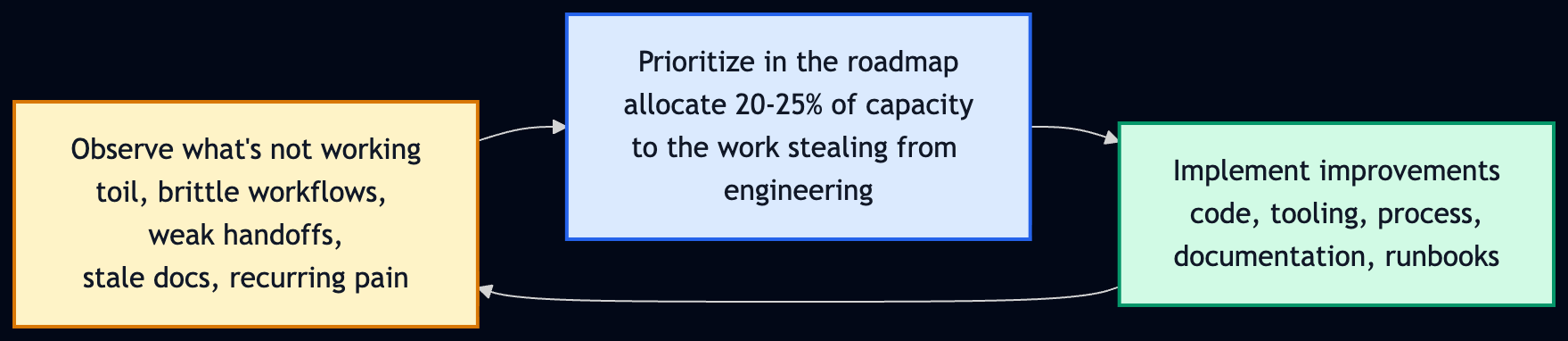 Engineering Health Loop
Redefining Resource Allocation
Engineering health gets framed too narrowly when we treat it as a maintenance bucket. A bit of cleanup here, a bit of support there, and then back to feature work. That is usually not enough. More often, we are allocating capacity in a way that keeps the symptoms alive.
Small inefficiencies, outdated scripts, awkward ownership boundaries, recurring manual steps, decisions made in a rush and never revisited. None of these looks serious enough on its own to win a roadmap fight. Together, they create a steady tax on the team. If you never allocate for that tax explicitly, engineers keep paying it silently.
Engineering health has to shape how we use engineering capacity in the first place. Otherwise we keep funding the visible work and starving the work that makes the visible work sustainable.
Creative Scheduling
One thing that helps a lot is to schedule engineering health work deliberately instead of hoping people will squeeze it in around delivery pressure. A simple rotation can work well here. Team members take turns focusing on engineering health tasks, which spreads the load and avoids turning one person into the permanent owner of all the unglamorous work.
This also helps with system understanding. When different engineers spend time on operational issues, production behavior, and recurring friction, more of the team learns where things actually break and what improvements would matter most. That shared exposure reduces knowledge silos and makes the team less fragile.
There is also a planning benefit. Once engineering health has a visible place in the schedule, it stops being the first thing sacrificed when deadlines get tight. Teams can track improvements, build context over time, and make deliberate progress instead of reacting only when something fails loudly enough.
Leveraging Cross-Functional Collaboration
A lot of engineering health problems do not belong neatly to one team. They sit in the gaps. Between domains, between responsibilities, or in areas where everybody depends on something but nobody really owns it. That is where cross-functional collaboration starts to matter.
Take something like synthetic test data for performance testing. If several teams need it and nobody owns it properly, each team ends up building partial workarounds, struggling in isolation, or waiting on someone else to care. A better move is to treat it as a shared engineering health problem and put a cross-team group around it. Give it clear ownership, let a few people drive it on behalf of the wider organisation, and solve it once in a way that helps everybody.
This works well because it reduces duplicated effort and makes the output more consistent. That lowers operational cost and removes a surprising amount of friction. I have also seen a lot of value in building teams whose job is to enable others. I usually think of them as ops teams. When they are set up well, they do more than support delivery. They reduce friction, improve reliability, and help product teams spend more of their time on product work instead of fighting the system around it.
A Manager's Perspective
From a manager’s seat, engineering health has to be pushed on purpose. There is always another delivery target, another visible feature, another urgent interruption that looks easier to justify. If you leave engineering health to spare time, it usually gets whatever is left after the roadmap has taken the best attention. What good looks like has to be defined early, or teams end up paying for fuzziness later.
I also think engineering health is a cultural work, not just technical work. A team’s systems usually reflect its habits. If people are rewarded only for visible output, hidden maintenance gets postponed. That is why this is tied so closely to trust, consistency, and the wider engineering culture of how systems are built and operated. Healthy systems do not come from one cleanup sprint. They come from repeated decisions that make quality, reliability, and follow-through part of the team’s normal rhythm.
A manager also has to help the team notice small fixes before they become expensive ones. A lot of improvements start as minor annoyances. Good managers create the conditions for those signals to surface, then help turn them into concrete improvements. That is how teams protect reliability, reduce noise, and avoid the trap of looking fast while quietly getting slower underneath.
This is also where incentives matter. If the system rewards only short-term output, people will keep stepping over the same mess to deliver the next thing. If you want engineering health to stick, the team has to see that preventing recurring pain matters just as much as reacting to visible fires. Feedback loops matter here as well. Some improvements work. Some do not. Some solve the local issue while creating a new one somewhere else. Managers need to keep that loop alive, so the team keeps learning instead of congratulating itself too early.
The Long-Term Benefits
The benefits of engineering health show up slow.It changes how the team operates, how predictable delivery feels, and how much energy gets wasted on avoidable problems. The first benefit is reliability. Teams that keep cleaning up weak spots, improving operational workflows, and dealing with debt tend to suffer fewer unpleasant surprises. Deployments become less stressful. Incidents still happen, because this is engineering, but they happen against a healthier baseline.
The second is simpler day-to-day operation. A healthier system needs less babysitting. Teams spend less time firefighting, patching around old decisions, or carrying fragile workarounds nobody trusts. That creates space for actual engineering instead of constant recovery work. Over time, that also becomes a cost advantage. Preventing larger failures is usually far cheaper than dealing with them once they have spread through the system.
There is also a team effect that I underestimated earlier. When engineers are not constantly dragged into the same preventable issues, morale tends to improve. The work feels less chaotic. Ownership feels more real. People have more room to think, build, and improve instead of just reacting. That stability also improves predictability. Teams that invest in engineering health usually have a much better shot at executing long-term roadmaps because they are not paying the same hidden tax every sprint.
All in All
The engineers who feel engineering health needs first usually do not make a big speech about it. They just get quieter. They stop suggesting improvements because the last few went nowhere. They build workarounds instead of filing tickets, because filing tickets stopped changing anything. They still do the job. They still absorb the drag. Then, after a while, they start looking elsewhere. Not because the work became hard, but because it stopped feeling worth the fight.
That is the cost that rarely shows up in a postmortem. No alert fires when a good engineer decides the system is no longer worth caring about. Nobody tracks the hours lost to rediscovering context that should have been documented, or the motivation drained by a deployment process that breaks in the same stupid way again and again.
That is why I do not see engineering health as a purely technical concern. Systems do not get tired. People do. Technical debt, brittle workflows, stale runbooks, all of that is real, but those are still the symptoms. The deeper cost is what they do to the people working inside the system every day, until friction stops feeling incidental and starts feeling like the job itself.
Most organisations already have an engineering health budget. They take it from the patience of the engineers who still care. Every time the same avoidable problem is deferred, a little more of that budget is spent. By the time leadership finally approves the work, the people who understood the system may already have decided it is no longer theirs to save.