
If you happen to work for a large organization, you’ve probably heard of quarterly check-ins or some similar corporate buzzword to describe what you’ve done and what you could have done better for the quarter. That’s fine, but both we as leaders and our direct reports always get caught off guard. I personally would scroll through Jira, Slack, and Confluence, trying to piece together what my team or I had actually accomplished.
I keep 1:1 docs and meet regularly with my direct reports, but when it came time to write their reviews, we still had to reconstruct our achievements from memory and scattered notes.
I also ask my direct reports to reflect on what they achieved each quarter. Some do it well, others stare at a blank page trying to remember what they did three months ago. The result is often biased toward the last few weeks, and smaller but important wins get lost. Some obviously keep track of their work better than others, but then it’s not always on the things we had agreed to focus on. Shameless plug, I suggest Caccepted to track!
I had heard of brag docs before, but I never really used them myself. Now, reflecting on my own experience, I’ve decided to change how we track achievements. I want to make it easier for everyone to remember what actually happened, when it happened, why we care, and what we care about.
The Problem with Quarterly Reflections
Quarterly reflections sound great on paper. They give people space to zoom out, see the big picture, and write a narrative about their impact. The problem is that memory is fuzzy. Most of us remember the last few weeks in detail and forget what happened early in the quarter. The recency effect means we overweight the most recent projects, incidents, bugs, and wins. This makes performance reviews skewed. The quarter can look great if it ended on a high note. Nonetheless, it feels worse than it really was if the last sprint was rough.
There’s another issue. The direct reports who are thoughtful and meticulous produce great write-ups. The disorganized or quieter ones who may have done just as much but are less inclined to document their wins often write very little. That doesn’t mean they contributed less. It just means their story is incomplete.
And then there’s the hassle factor: if someone has to write it all at once, procrastination kicks in. Their work looks less complete than it actually was, and they don’t get the credit they could. Even if they write, what I deem to be important for them might be different than what they think is important.
As a manager, this creates friction. I know the work happened, but we still have to piece it together from 1:1 notes, tickets, and our own memory. It takes time and energy. Hence, we can do this better.
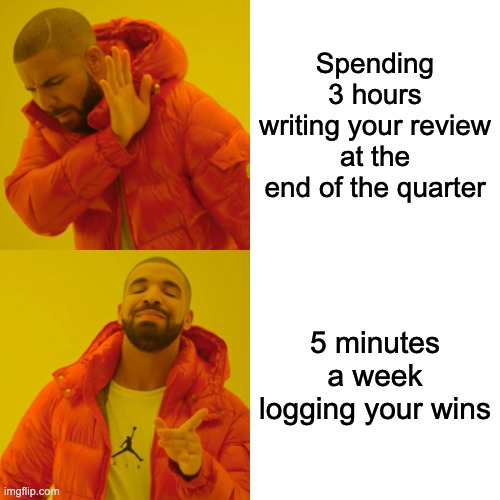 Bragging About Your Work
Research & Insights
The idea of tracking achievements isn’t new. Many teams use brag docs, weekly updates, or private Slack channels to capture wins. I’ve done something similar before: weekly team newsletters that stitched together everyone’s achievements. We have also done personal write-ups at the end of each week to capture what each individual actually achieved.
This does a few things: it creates transparency, builds accountability, and forces you to reflect on your work. It’s harder to do at scale in a large organization, which is why I prefer to keep it in the 1:1 context.
I went down a rabbit hole recently reading discussions about brag docs, and the pattern was clear. Engineers who tracked their wins weekly found performance reviews faster, more accurate, and less stressful. When people write things down regularly, they’re more likely to notice their own progress and managers are less likely to miss important contributions.
Of course, there are trade-offs. Some argue that brag docs turn performance reviews into marketing contests. Some others say it's the manager's job to track team contributions, not the team’s job to pitch themselves.
I agree with that criticism, at least partly. It is a manager’s job to know what’s happening on their team. But self-reflection matters too. Asking people to write down what they did is beyond performance reviews. They help themselves to see their own growth, take ownership of their impact, and make invisible work visible.
Weekly Achievement Tracking
Rather than relying on quarterly reflections, I’m moving to a simple weekly rhythm. Every direct report keeps a short running log of what mattered that week.
The goal is not to create more paperwork. It is to make achievements visible while they are still fresh. Here’s the lightweight format we use:
- Win: The key thing you shipped, fixed, unblocked, or improved
- Impact: Any measurable result. Latency drop, cost savings, customer impact.
- Evidence: Link to a doc, PR, Jira ticket, or screenshot
No storytelling, no polish, just facts.
These updates go into the same shared 1:1 doc we already use, so they become part of our ongoing conversation instead of an extra tool. When we meet, we can discuss them, connect them to team goals, and spot patterns early. By the time quarterly reviews roll around, we have a living record.
This approach keeps ownership with the person closest to the work. They control what goes in, I add context and recognition, and we both have a clear picture of impact over time.
Why This Is Different from 1:1 Notes
It might sound like we are just duplicating 1:1 notes, but the intent is different. 1:1 notes are a mix of updates, coaching points, feedback, and action items. They capture the conversation we had that week. What was top of mind, what was blocked, what we planned next. They are valuable, but they do not have a clear record of wins.
Weekly achievement tracking forces a moment of reflection. It asks each person: What was the most impactful thing I did this week? The answer is often buried in the noise of the chaos or lost in the flow of meetings. Writing it down elevates it, makes it visible, and gives it a place in the bigger story of their work.
Tracking achievements complements 1:1 notes by creating a running highlight reel of the quarter. This is something for both manager and direct report to revisit when it’s time to talk growth, promotions, or performance.
Making It Data-Driven
Weekly achievement logs are not just a list of tasks. They need to connect back to the outcomes we care about as a team or individual. I often share my own goals with the team. So, they can see how they can contribute towards them. Say, we have a hiring target, if you did 5 interviews, it simply means you contributed towards it.
This is where goals and metrics come in. At the start of each quarter, we set goals. It can be reliability targets, delivery milestones, customer impact metrics. The weekly log should tie achievements to those goals wherever possible.
- If you reduced latency, write down the before-and-after numbers.
- If you improved reliability, include the change in error rate or support tickets.
- If you unblocked another team, mention what that enabled downstream.
This makes the log more than a journal. It becomes evidence. It shows not only what was done, but why it mattered.
Being data-driven also helps with fairness. When we review performance, we are not just looking at who wrote the longest brag doc. We are looking at measurable impact aligned with the goals we agreed on as a team.
Call to Action
If you lead a team, try this. Pick a simple template, ask your direct reports to spend five minutes each week writing down their wins, and tie them to the goals you care about. Keep it light, keep it private, and make it part of your 1:1 rhythm.
If you are a direct report, you don’t need to wait for your manager to set this up. Start a personal log today. In the future you will thank yourself. It’s not just at review time, but every time you need to remember how far you’ve come.
The point is not to create more processes. The point is to make achievements visible, connect them to outcomes, and use them as fuel for growth. Performance reviews should not be an archaeology project. They should be a conversation about impact, and a plan for what comes next.