
One of my friends from primary school didn’t go to high school. At first, it was a bit surprising, but his family was making kebap, and he wanted to run the family business. Because of some family problems, they lost the business and had to start over.
I was always surprised by how he did a few things all the time. He always saved money. Always came early. Even when we were playing football, he was the first to arrive. He always answered when called, remembered people, asked if the food served was good every time he served, and so on.
I was too young to understand, and probably he was too, how much this would affect his life. But after our mid-twenties, it started to show. He opened his own place, then another, and then a whole chain. He kept those same habits all along. At first, you think those aren't big deal but then you realize that’s a big part of his success. When we talked years later, he also confirmed those helped him.
In my years of working, I’ve been privileged to work with some truly remarkable individuals. These experiences have taught me a crucial lesson. What made them remarkable was how reliably they showed up. In this post, I will tell a few ways those people showed consistency in what they are doing.
Consistently Delivering Excellence
Over the years, I have worked with people who impressed me once, and others who earned my trust over time. The second group stayed with me. Whenever they touched something, they left it better. Their work was easier to understand, the problem was less likely to return, and the next person had less mess to deal with.
That is what consistency means to me. Not being brilliant every day, and not constantly trying to prove yourself. Just doing good work often enough that people know what to expect when you are involved.
We are what we repeatedly do. Excellence, then, is not an act, but a habit.
Aristotle
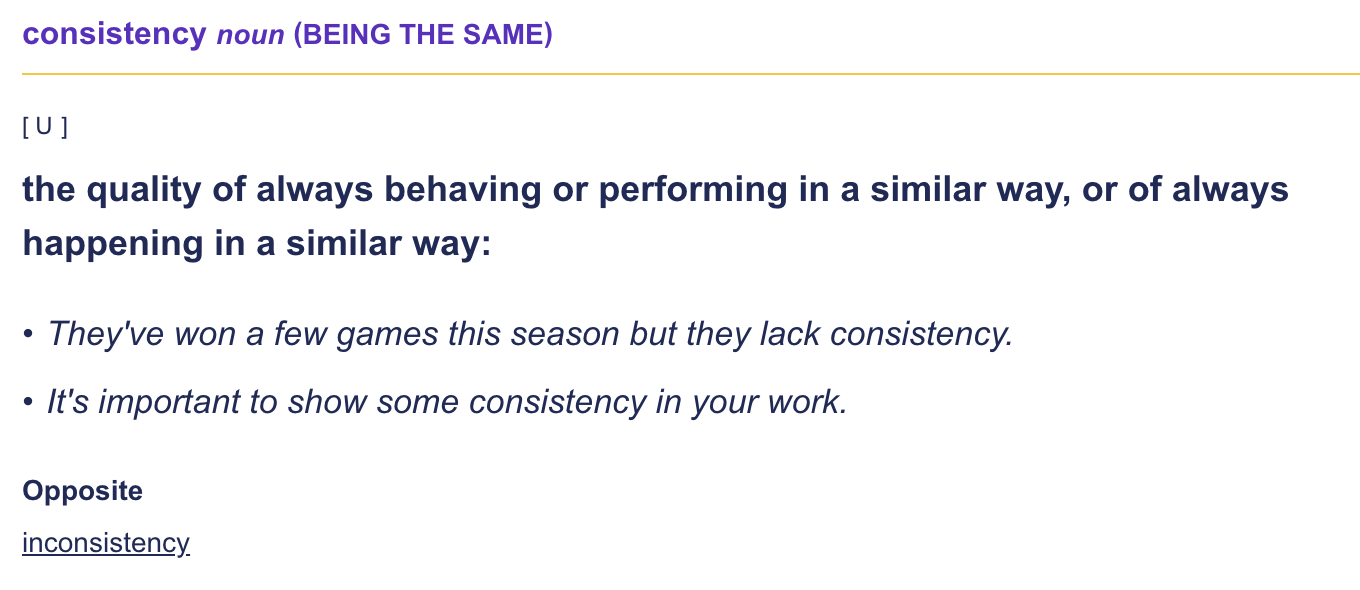 the definition of consistency
Consistently Caring and Showing Empathy
You remember the colleagues who make time for you when they do not have to. When I was trying to understand my paternity leave, the policy was not clear to me because the US and EU rules did not line up. A colleague sat down with me, worked through what I was actually entitled to. Later, I realized he did the same for other people too. It was not a favour reserved for me. That was simply how he treated people, and those things stay with you.
People will forget what you said, people will forget what you did, but people will never forget how you made them feel.
Maya Angelou
Consistently Tackling Challenges
I still remember when my team had to add a new tracking feature to the frontend. None of us had much experience there, but one engineer stepped in and took responsibility for figuring it out. He learned enough to get us moving, broke the work into parts we could handle, and helped the rest of us whenever we got stuck.
What stood out was that this was not a one-off. He did the same thing whenever the team entered unfamiliar territory. He did not need to know everything before getting involved. He would learn what was needed, make the problem less confusing, and help everyone else move with him. After a while, he became the person we trusted when the path was unclear.
Challenges are what make life interesting and overcoming them is what makes life meaningful.
John C. Maxwell
Consistently Right
Some people seem to be right more often than everyone else. It is tempting to call that instinct, but usually there is more going on. They look for what they might have missed, listen to people who see the problem differently, and change their mind when the evidence changes. They are not attached to being right about the first answer. They care about reaching the right answer before the decision has to be made.
Good judgment builds this way. You make a call, watch what happens, and remember where your reasoning failed. Over time, you notice more, assume less, and correct yourself sooner. Being right often is not the absence of mistakes. It is getting less comfortable with carrying the same mistake forward.
Consistently Evolving
Lastly, the people who stood out never seemed finished. They kept trying to understand more, not only about the technical work, but about the business around it and the people doing it. They asked better questions, noticed where their knowledge was thin, and made an effort to close the gap.
That learning did not only benefit them. It helped the team make better decisions, avoid old mistakes, and deal with problems that would have been much harder a year earlier. Their growth showed up in what everyone around them became able to do.
Love of learning is the guide of life.
Carol Dweck
In Essence
The best colleagues change how you work around them. You stop double-checking whether something will be done, wondering whether they will disappear when it gets messy, or preparing for the cleanup afterward. Their consistency removes doubt, and that gives everyone else more room to think, decide, and move.
My test is simple. I would hire them, and I would want to be hired by them. That is what real respect looks like from both sides of the table.