
In the Roman Forum, there was a small shrine with double doors. When Rome was at war, the doors were left open. When Rome was at peace, the doors were closed. It is an oddly modern idea. A binary signal. A public status indicator. At a glance, you knew what state the system was in. Open meant war. Closed meant peace.
January carries the same logic. It is named after Janus, god of thresholds or doors. A threshold is a crossing point where rules change. Last year’s defaults do not have to be allowed through the door. That is why access matters more than motivation.
Motivation is fog. Doors are policy. Doors decide what gets in, what stays out, and what is allowed to interrupt your life. Access is the whole game. Now zoom out. Most of us keep our doors open all year. Be it phone, inbox, calendar, or other people’s urgency. Everything gets access, everything can interrupt, everything can escalate. That is war mode.
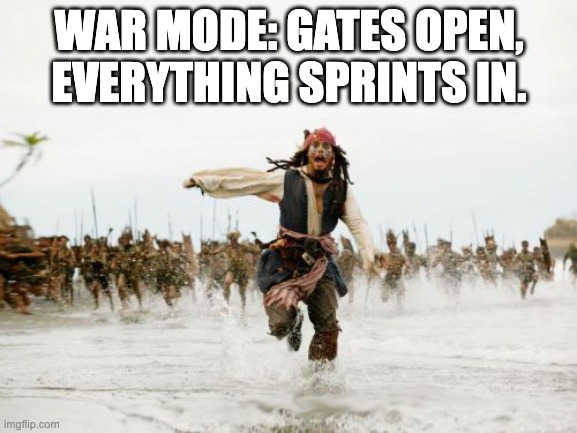 Meme of Jack Sparrow running through shallow water with soldiers chasing him
War Mode
Most people are not busy. They are open. Anything can enter your day. A message turns into a call. A call turns into a meeting. A meeting turns into a project. A project turns into a commitment you drag for six months. I don’t think that is productivity. That is reachability.
Rome had a visible signal for this. When it was at war, the doors were open. War mode is the same pattern. The door stays open, so everything walks in. A small request can escalate because there is no gate.
- Your phone is a gate.
- Your calendar is a gate.
- Your inbox is a gate.
- Your habits are gates.
- Your relationships are gates.
War mode is what happens when all gates are open by default. You will still do work in war mode. You might even do a lot of it. But it will feel like you are always catching up to something. You respond fast, yet you do not move forward. It doesn’t feel like building, does it? You feel the reactive nature of it.
Peace Mode
Peace mode does not mean you are not ambitious. It means your ambition is not available to everyone. You are not constantly reachable. You do not treat every ping as a summons. You decide what gets in, when it gets in, and what must wait outside.
Let’s be honest. Some things simply do not qualify for our time. Not because they are evil, but because they are noisy. Peace mode has standards. It has filters. It has a default “no” unless something earns a “yes.” I always jokingly say no is my default answer. The joke is not really a joke.
Peace mode is designed. It is enforced. It is not wished into existence. This is where Janus becomes useful. Not as a myth, but as a model. The New Year is a threshold, a doorway where rules can change without apology.
So the question is simple. What gates will you keep open this year, and what gates will you close?
 The Janus Protocol
New Year Planning
Most people do New Year planning the same way every year. They set goals, promise discipline, and silently assume the year will cooperate. It will not. This year will be messy. People will interrupt you. Work will expand. Life will happen. The calendar will not respect your intentions.
If your plan requires a perfect year, expect the usual. Instead, build a gate policy. Something that still works when you are tired, distracted, traveling, sick, overwhelmed. Something that assumes reality.
- It assumes interruption.
- It assumes friction.
- It assumes you are human.
Goals are outcomes. Gate policies are constraints. And constraints are what make execution quiet.
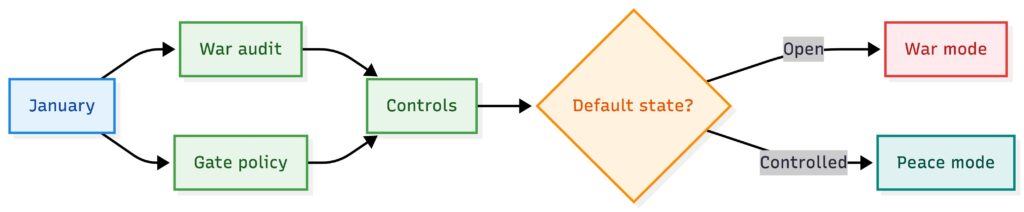
The Janus Protocol
This is a New Year ritual you can do in 30 to 45 minutes. You do not need a vision board. You need rules.
Step 1: Run the War Audit
Open a note. Title it: What put me in war mode last year? Then answer these, quickly and honestly.
Time breaches
- What repeatedly hijacked my mornings?
- What turned weeks into scraps?
- Where did I lose entire days to “just one more thing”?
Attention breaches
- Which apps or feeds pulled me into reactive spirals?
- Which group chats acted like a public square?
Calendar breaches
- Where did meetings expand because there was no default boundary?
- Which recurring meeting gave me nothing and still kept happening?
Work breaches
- Which projects had unclear ownership?
- Which projects had no definition of done?
- Where did I carry work in my head because the system did not hold it?
Relationship breaches
- Where did I say yes to avoid discomfort?
- Which people had unlimited access to my time?
There’s not much to overthink. You are looking for patterns. At the end, pick your top three sources of war. Write them as bluntly as possible.
- “Unplanned meetings.”
- “Phone in the morning.”
- “Too many parallel projects.”
- “Saying yes too fast.”
- “Always-on messaging.”
These are your open gates.
Step 2: Write your Gate Policy
Now you will write rules, not intentions. Use this template.
- Gates I am closing this year (3 items)
- Gates I am opening intentionally (3 items)
- Gates I keep half-open with conditions (2 items)
Then turn each into an actual policy. Policies need mechanics. Remember this has nothing to do with being rigid. This is a good old boundary setting. You are being clear. Clarity is kindness, to yourself and to others.
Step 3: Install Controls
Pick one gate and enforce it with defaults. If your gate is your phone:
- Do Not Disturb until a certain time.
- Remove the most tempting apps from the home screen. Mine are slack and outlook.
- No notifications except people.
If your gate is your calendar:
- Create meeting buffers.
- Block two deep work sessions each week.
- Require an agenda for meetings.
- Reject meetings that should be a message.
If your gate is your work:
- Set a hard limit on active projects.
- Make the definition of done explicit.
- Park everything else.
- Handle leadership requests proactively.
If your gate is social access:
- Choose certain days for spontaneity. I suggest days you are in the office.
- Put constraints on plans that drain you.
- Say yes with conditions. People don't like conditions. You might get free!
A policy you do not enforce is a fantasy.
Step 4: Close One Gate First
Do not try to fix your whole life in January. Choose the gate that created the most war. Close it first. Let peace compound. One gate at a time. See the difference.
Four High Leverage Gates
1) The Calendar Gate
Most people think time management is about willpower. It is about defaults. My calendar has many blocks. If people do not see free time, they simply find time later or text me. My time isn’t being auctioned. Think about a simple calendar gate for yourself such as:
- No meetings before 11:00 for some days
- Blocks for lunch and dinner. I just want to enjoy my food.
- No meeting without an agenda.
- Two deep work blocks per week.
This one gate changes your year because everything else sits on your calendar.
2) The Communication Gate
Always-on communication creates war mode. You become a router. You stop being a builder.
A simple communication gate:
- Check messages two times per day.
- Respond fast only to true escalations.
- Everything else gets scheduled. I love marking things later. I sometimes come back in few days.
Most questions can wait. Waiting is a good thing. When I respond to them, I have full attention instead of a broken one. It makes me more reliable.
3) The Work-in-Progress Gate
Too many parallel projects is the easiest way to be busy and unproductive at the same time.
A simple WIP gate:
- Maximum two active projects. Even for a manager. You can’t track so many projects effectively.
- Everything else is either rejected, delegated, or parked.
- Parked work is not “in your head.” It is visible somewhere. Call it deprioritized or whatever makes sense.
This one is brutal at first. Then it becomes peaceful.
4) The Attention Gate
The attention gate is the most silent one. It is also the most expensive. If your attention is open all day, you will feel exhausted even if you did not do anything heavy. A simple attention gate:
- No phone before breakfast.
- No scrolling in bed especially for work.
- Social media is limited by phone, say 15 minutes. That's my restriction.
You do not need to quit the internet. You need to stop living inside it.
Teams Have Doors Too
So far this was personal. Phone, calendar, inbox. Teams have gates as well. They are just less visible.
- Production is a gate.
- Oncall is a gate.
- The release process is a gate.
- Dependencies are gates.
Org war mode is what happens when those gates are open by default. Most interruptions are not random. They repeat. Same incident patterns, same alerts, same classes of bugs. Slightly different but same root cause.
And some of the most expensive interruptions are imported. Another team/org upgrades their infrastructure. Something shifts. You absorb the blast radius. A “small fix” turns into a week of work, then a handful of follow-up projects you never planned for.
That is war mode at the org level. Uncontrolled access. Peace mode is again designed. It looks like simple gate policies:
- Dependency gates: change windows, versioned interfaces, contract tests, staged rollouts.
- Repeat-incident gates: recurring incidents are a tax. Third time becomes an elimination task, owned and scheduled.
- Intake gates: one entry point, triage cadence, WIP limits
- Tech debt: addressing your debts on time will bring health
Same principle as personal life. If everything can enter at any time, you are at war. If entry is controlled, you can finally build. Obviously, you need to welcome some randomness. Shit happens!
All in All
January is the threshold month. That is literally what it was named for. A doorway is not a goal. A doorway is a boundary. A doorway is where you decide what crosses, and what does not.
The New Year works as a ritual because it gives you permission to change rules. Most people use that permission to promise outcomes. Use it to rewrite access. Close the gates that kept you in war mode. Open the gates that support peace. So,
- January is a doorway. Treat it like one.
- War mode is what happens when everything has access to you.
- Peace mode is controlled access. It is not comfortable. It is design.
- Goals are outcomes. Gate policies are constraints. Constraints create quiet execution.
- Write your gate policy, then enforce it with defaults.
- Close one gate first. Let peace compound.
If you want a different year, do not ask for a different personality. Change who and what has access to you. Close the gates often enough that you can finally build in peace.
Happy new year!