
In 1997, Jeff Bezos sent a letter to shareholders about Day 1. Despite the rapid growth he was seeing, he wanted to keep the startup mentality. He wanted to give ownership along with financial reward by stock options. I have worked for AWS and I know some of the Day 1 philosophy stuck and some teams and products did actually move with that, including AWS itself. So, the startup mindset is nothing new but the pressure is growing on all of us without the right set of primitives.
Come today, everybody wants to operate like a startup without the right incentive structure and right level of ownership because our collective output can be much higher due productivity gains in AI. If there’s a productivity gain, there is no need for 10% of employees, managers, engineers, what have you, because presumably we are moving fast with less fat. I always believed in small teams, and I still do because of the lack of communication overhead, but even if you trim 10% of 40k employees, you won’t be small. Even worse, you don’t have small teams structurally as well.
The productivity premise is also untamed. I see that the gain is real for an individual who controls their own decisions. At organization scale, reviews, compliance, and diffused ownership absorb much of it.
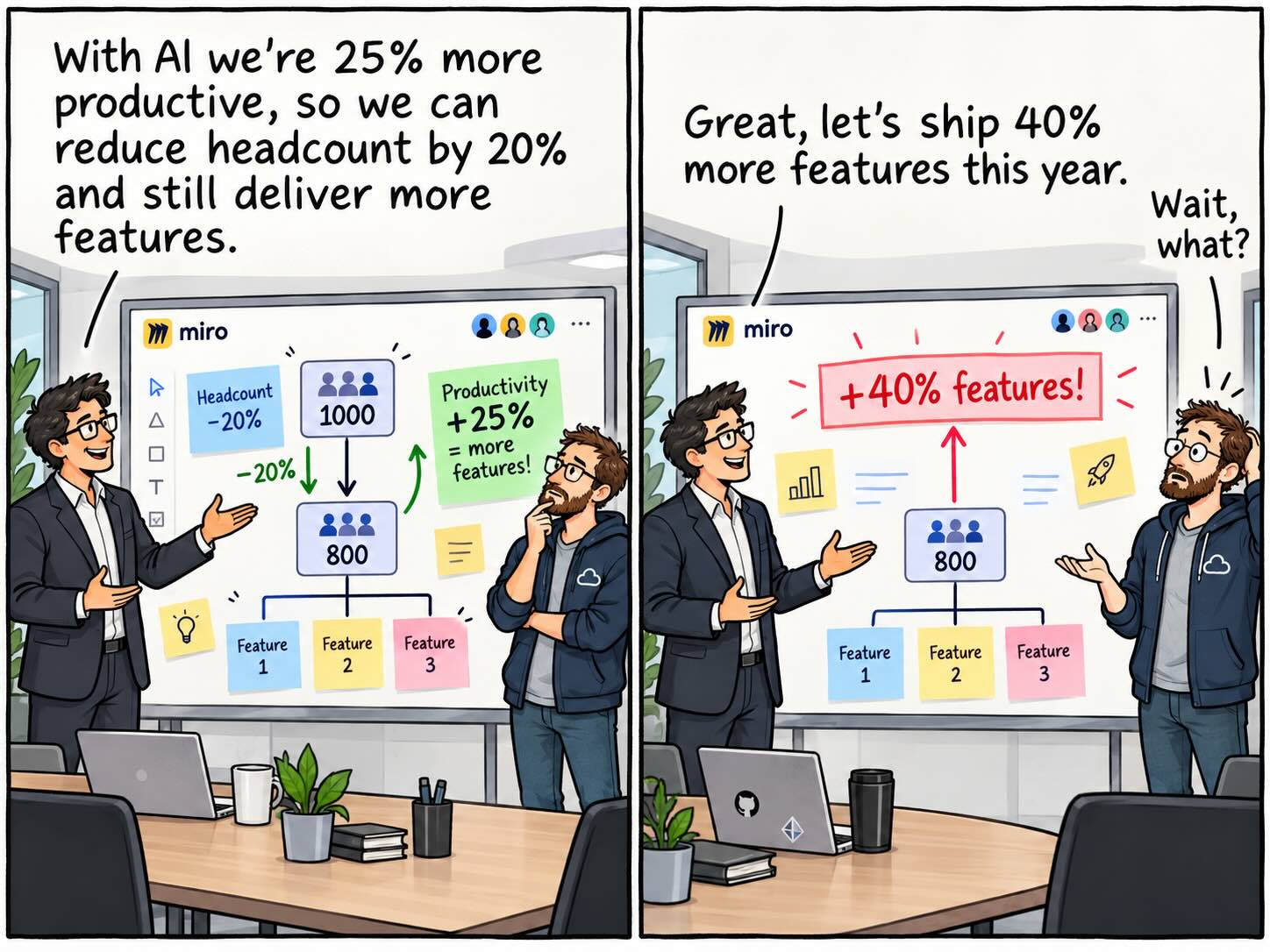 AI Productivity Math
We Already Spent the Gain
Now, suppose we have an engineering organization with 1000 engineers. Say we gained 25% productivity. And we also decided to lay off 20% because we became more productive, that leaves us around 800 engineers. For arguments sake, assume productivity gain is real. We’re literally left with the same capacity. And this kinda makes sense if we're 25% more productive at everything, not just writing code.
Some companies stop there, and that is a reasonable trade. Many simply don’t. They are asking for more. We should deliver 40% more features because we became productive, right? That is 1,400 engineers of work from a 1,000-engineer org. We’ve counted the same gain twice, once as savings and again as delivery capacity. We probably don’t even have that much capacity. Reorgs push people into areas they don’t know yet. Guess what, ramping up takes time. Spans of control grew too, so managers have less attention for each engineer. Then the very good engineers who knew their areas in and out may start leaving.
Cutting 20% saves money immediately. Nonetheless, now we're asking fewer engineers to deliver more than before. Where is that capacity supposed to come from? Headcount math doesn't capture reorg ramp-up, coordination overhead, or shrinking spans of attention.
You Already Have Customers
Startups have different risk appetite, they can move fast, ditch a built product or shift the strategy on a certain area fast. They can put a team and move on. They take risks to find customers who can pay for their product. And all of these can be justified but what about a company with many customers already can they do the same?
Assuming you really did gain productivity, you cannot literally open new fronts, launch products, sign off deals and say, "oh you know what, this isn’t working for us." What do you think your customers think about it? What happens when you need to support it for real? That’s not someone's toy project right? It has to scale, accept traffic, adhere to compliance and security practices. None of these are free. You can’t break your SLAs because you want to get something shiny out. A new product might increase revenue but missing your SLAs might result in losing revenue.
And somebody still has to support all these shiny features. Engineers will get paged in the middle of the night for code they barely understand because AI wrote it and everyone was asked to move fast. They're still accountable for fixing it, even though the decision to take that risk came from several layers of management above them. Keep doing that long enough and people burn out. I don't think we're prepared for that.
Risk Reward Ratio
And if we're asking engineers to absorb that risk, what do they get when the bet pays off? In a startup, a big bet can pay off asymmetrically because engineers can be compensated for it. Working 60 hours a week can be a fair deal for a while, at the right stage of life. I did that a few times earlier in my life. One time, I ended up not being paid at all!
Nevertheless, the same promise doesn’t hold in a large corporation. You are paid some base salary, and shares. No matter how much you could try to influence, you’re still a dot in a game. You still have chains of management for the right reasons. It’s just a different beast. Even if you put time into getting things done, your upside is not the same, at the very best you’ll get a promotion with maybe 10-20% comp increase and that needs to go through the promo committee.
Everyone is asked to move with the urgency of a tech founder at a place where people are leaving or let go while everything is shaking. I don’t think that can bring sustainable growth.
Where’s the Gain
I am completely positive about AI gains. I have been writing little tools, implementing ideas here and there, and it did help me a lot but most of this is limited to my own personal experience. I don’t see changes going faster in larger organizations due to inherent reasons like reviews, compliance, understanding and level of ownership. In a project I'm doing myself, I’m my own boss, I decide anything and everything.
I wonder how this will shake after all the dust settles. I think we need to wait 2-3 years. That’s what happened with covid. It took a while for companies to understand they overhired for things they didn’t end up needing. Now, it’s quite a different era. We may end up building things customers don’t want or need. Hence, there would be some retraction and trimming off in the future.
Going back to what Bezos said in his letter, he tied success to repeat purchases. Before we trim our teams to the bone and demand startup-level urgency, I'd like to see whether customers are coming back and whether the business actually grew.