
Decisions rarely wait for me to feel ready. I’ve lost count of how many times I wished for more data, more clarity, more time but the world kept moving anyway. The art of making swift decisions in business is something I’ve had to learn the hard way. It’s less a skill and more a survival instinct you develop over time. Most days, you don’t get the comfort of certainty. You move first and understand later.
Imagine how Super Mario moves through levels filled with obstacles, enemies, and power-ups while time is limited. Mario doesn’t have the luxury of time to think over every jump or dodge. He must act with instinct and reflex. This allows him to survive and succeed. Similarly, in the corporate world, making decisions often requires agility and precision. And as strange as it sounds, a video game explains this far better than any management book.
I’ve seen this play out countless times in my own work. There are moments when you want all the data, all the scenarios neatly mapped out. Nonetheless, the deadline doesn’t wait. A customer issue at 3 a.m., a release blocker right before launch, a competitor moving faster than expected. In those moments, the worst thing you can do is freeze. Acting with speed, even if imperfect, often puts you miles ahead of waiting for the “perfect” call that never comes. And just like Mario, you learn to trust your instincts, take the leap, and adjust mid-air if you have to.
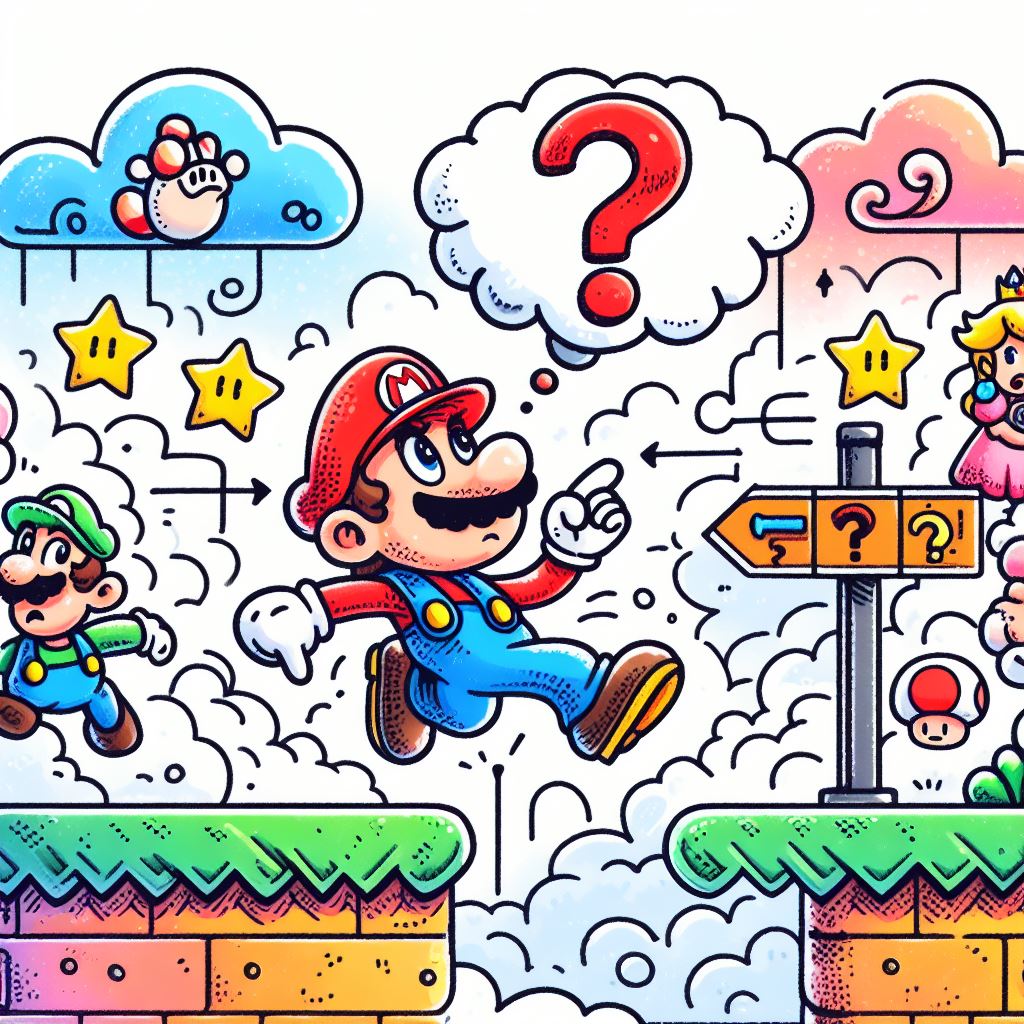 Super Mario Decision Making
The Dynamics of Decision Making
Timing is the part people underestimate. Over the years, I’ve realized that hesitation often costs more than a wrong call. A wrong call teaches you something. Hesitation just leaves you behind. And in my experience, the moments I stalled were always the ones I regretted the most.
It isn’t about always being right or wrong for that matter. It’s about pushing forward, learning faster, and building the confidence to decide again when the next fork in the road appears. Most decisions don’t feel dramatic in the moment. Nevertheless, they gradually shape how you operate, how your team operates, and how quickly you recover the next time things go sideways.
Indecisiveness is a Loss
Every moment of hesitation can be costly. In volatile markets, fund managers are all too aware that a delay in response can mean millions down the drain. Engineering isn’t any different. Not committing to a direction or feature could mean losing out to a competitor. Or when a team doesn’t commit to a clear direction, it can lead to a lack of progress.
On one project, we delayed the decision to shard a database that had already crossed 1TB. Read latency rose from 40ms to 250ms within three months, batch jobs slipped past their windows, and the system woke us up every other week. By the time the team committed, migration required weeks of planning, custom tooling, and off-peak cutovers. Work that would have been trivial if the decision had been made earlier turned into a major effort. The cost of hesitation was clear. We had degraded SLAs, increased oncall hours, and erosion of trust in the platform. Looking back, the real failure wasn’t the technical debt. It was how long we were afraid to call it what it was.
Navigating the Gray Areas
Decision-making in management is seldom black and white. It is a spectrum of grays, and most of the time you are choosing the least-wrong option, not the perfect one. The data rarely resolves cleanly, and production traffic almost never behaves the way the benchmark promised.
I remember a case where we had to decide whether to scale a service vertically with larger instances or invest in horizontal scaling. Benchmarks showed advantages in both directions, but none were conclusive under production traffic patterns. Waiting for perfect data would have stalled the release. We chose horizontal scaling, knowing it might create extra complexity, but it gave us a path forward. In hindsight, the decision was not flawless, but it was better than standing still.
Embracing the Wrong Calls
Making mistakes as we decide is normal and expected. Scientists found that even monkeys aren't sure what to choose sometimes, their minds flipping back and forth until they finally commit. Uncertainty is the default state, and each wrong choice still teaches you something that sharpens the next one.
What matters is how quickly a wrong call is recognized and what is done afterward. In practice, most engineering mistakes are reversible if caught early. A feature can be rolled back, a schema can be adjusted, an incident can be mitigated. What cannot be recovered is the time wasted avoiding the decision in the first place. The real danger is not choosing wrong. It is refusing to choose. Each wrong turn adds to a body of intuition that sharpens the next call.
Learning from Each Decision
In engineering, each call whether right or wrong becomes part of the team’s collective muscle memory. A decision about architecture, incident response, or deployment strategy leaves behind traces in runbooks, tooling, and instincts. Over time, these traces accumulate into pattern recognition. What once required hours of debate becomes a reflexive judgment made in minutes. This is how teams evolve. They stop trying to eliminate mistakes and start folding every outcome back into the system as experience.
People at the Heart of Hard Choices
The toughest decisions involve people. Hiring, firing, pivoting a team in a new strategic direction, this is where decision-making moves beyond logic and data. You can measure performance, track delivery, and compare skill sets, but you cannot reduce a person to metrics alone. The human element introduces complexity that no model captures, and here empathy matters as much as speed. A decision made without regard for its human impact may solve the short-term problem while opening fractures that take far longer to repair.
The Reflex Is Built, Not Given
Speed without accuracy is just a faster way to be wrong, so the goal was never reaction time for its own sake. A team that reads a situation quickly and still commits to the least-wrong option beats a team that waits for certainty that never arrives. That reading is the residue of every earlier call they were willing to make, watch fail, and correct.
Mario does not clear the level by studying it. He clears it by jumping, missing the platform, and adjusting before the next gap arrives. The teams that move with confidence are not the ones that guess right more often. They are the ones that stopped treating hesitation as caution. The decision you are avoiding is not getting cheaper while you wait.