
Lately, Iʼve seen a lot of posts about what employers should do or how they should treat candidates, what benefits they should offer, and how they should run their interviews. I understand where that sentiment comes from. I relate to it too; I’ve been ghosted by recruiters and left without feedback after long interview rounds in the past. These experiences are frustrating, and the frustration is valid.
But here’s the part we need to acknowledge. The tech job market right now is an employer’s market.
Just like the housing market shifts between a buyer’s and a seller’s market, the job market moves between an employer’s and an employee’s market. At this moment, the balance of power clearly leans toward employers. There are several reasons for this: layoffs, economic uncertainty, and an oversupply of talent. Simply put, there are far more candidates than there are open roles.
When the queue is full, behavior changes. Response times get worse, standards get fuzzier, and employers start treating optional filters as hard requirements. From what I recall, weʼve only seen a market this skewed once or twice before during the 2008 crash in tech and perhaps during the dot-com collapse but even then, it didnʼt feel this harsh.
That does not mean the market is dead. It means the market has become slower, pickier, and more uneven. Some teams are still hiring. Others keep roles open while behaving as if every hire or backfill needs a three page justification.
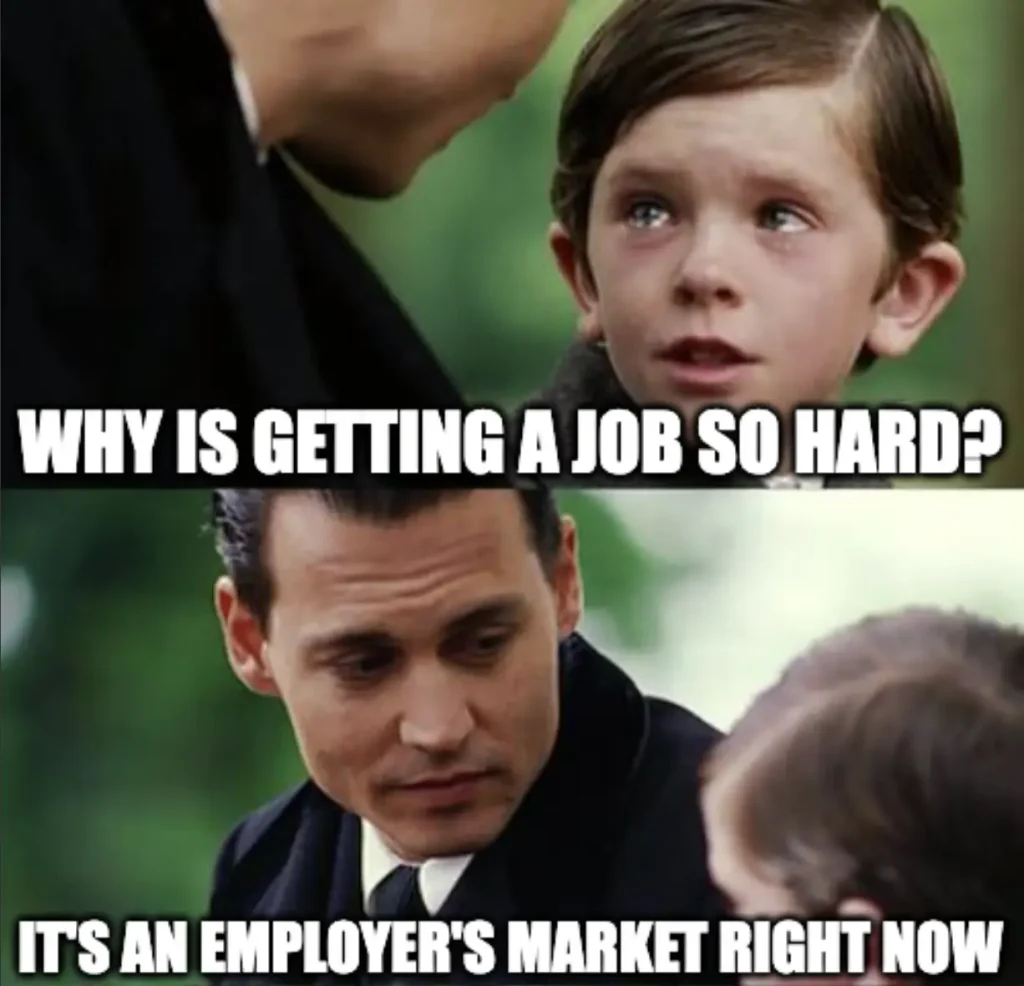 Kid: "Why is getting a job so hard?"
Adult: "It's an employer's market right now, but don't lose hope. Your time will come."
Kid: "Why is getting a job so hard?"
Adult: "It's an employer's market right now, but don't lose hope. Your time will come."
Obviously, this isnʼt good news for anyone who recently got laid off, graduated, or is searching for a new role. It means that, for now, employers hold more leverage. They can be more selective, take longer to make decisions, and even offer lower compensation than what was standard a couple of years ago. That’s what happens when supply outweighs demand.
Some of this is rational. Some of it is sloppy. A strong market for employers gives good companies room to be careful, and bad companies cover to be careless. You can see this shift just by looking at job postings. The volume of applicants per role has exploded, and as a result, the behavior changes. Employers aren’t chasing talent anymore; talent is chasing jobs.
Employer Dynamics in Tough Times
Of course, most employers aren’t intentionally trying to be ruthless. But the reality is that they can afford to be more discerning because the pool of available candidates is larger and more competitive. The number of engineers looking for work far exceeds the number of open roles, and that imbalance shapes behavior.
For many job seekers, that means the interview process may feel tougher and the standards higher than before. Unfortunately, it can also mean worse interactions. Slow responses, inconsistent updates, or a complete lack of follow-through. Sometimes employers don’t even honor a basic level of commitment, simply because they don’t have to in this market.
Does this mean employers should treat candidates poorly or ignore the human side of hiring? Absolutely not. But it does mean we need to understand the context we’re operating in. Just like the rules of the game change in a buyer’s vs. seller’s market, the dynamics of job hunting shift in an employer’s vs. employee’s market.
Stop Fighting the Wrong Battle
Complaining about it won’t move you forward. It has never helped anyone land a job. In an employer’s market, leverage only comes from competence and differentiation. I think that is the part many candidates overlook. The tough truth is simply this. Companies do not change their behavior because candidates ask them to; they change their behavior when the market forces them to.
In an employee’s market, candidates walk away from bad processes, and companies adjust. In an employer’s market, candidates walking away doesn’t change anything. There are ten more waiting. That sounds harsh because it is harsh. But pretending otherwise creates the wrong strategy. So instead of trying to change the market, focus on positioning yourself inside it.
Ask yourself:
- How do I become one of the few candidates employers cannot ignore?
- What proof of competence can I show that instantly reduces perceived risk?
- What signal can I send that makes me stand out from 500 applicants?
This approach may not feel emotionally satisfying, but it is effective. The market does not reward fairness. It rewards reduced risk. If two hundred people can do the job on paper, the person who shows the clearest proof gets the advantage. That proof can be a referral, a shipped project, a clean portfolio, a sharp technical explanation, or simply a CV that does not make the hiring manager work too hard.
Navigating the Market as a Job Seeker
So, if you’re a job seeker right now, what should you do? First, acknowledge the landscape. It’s a tough market. It means you may face more rejections, longer waiting periods, and perhaps offers that aren’t quite what you hoped for. This doesn’t mean you’re not talented, capable, or deserving. It simply means you’re operating in a difficult cycle.
Second, focus on what you can control. A generic CV is expensive in this market because it asks the reader to infer too much. Make the signal obvious. What did you build? What changed because of your work? What scale did you operate at? What did people trust you with? These are the levers that still move the needle, even when market conditions don’t. And most importantly, don’t let the harshness of the market make you doubt your value.
I would also avoid relying only on cold applications. The anonymous queue is the worst place to compete when everyone looks qualified enough on paper. Weak ties matter here: former colleagues, old managers, people from adjacent teams, or someone who saw you do one useful thing. They may not know you deeply, but they can attach enough context to your name to get you out of the pile.
All in All
This employer’s market won’t last forever. Just like any cycle, the balance eventually shifts. I know it isn’t easy. Nevertheless, ignoring the reality won’t help you stand out. In fact, understanding the state of the market helps you make better decisions, set healthier expectations, and stay grounded.
The tide will turn again, but that does not help much if you are searching today. For now, the useful move is to stop reading every rejection as a verdict on your value and start treating the market as a constraint. Constraints are annoying. They are also workable.