
I don’t know the last time I rated a movie 10 out of 10. I went to IMDb and found out it was in 2014. I’m more selective now when I watch movies, but that doesn’t change how good Crouching Tiger, Hidden Dragon is. It’s not like anyone cares about my ratings. I mostly use them as a personal repository to remember what I watched, what I might want to rewatch, and what probably doesn’t deserve another round.
While watching Crouching Tiger, Hidden Dragon, I simply couldn’t believe how good the cinematography was. Not just the landscapes or the famous fight scenes, but the way the film reveals hidden layers. The way silence, movement, and restraint carry more weight than most dialogue in modern films.
When it ended, I was stunned in a good way. Then I asked myself the usual question. What would I rate this? Yes, a 10. But why though? What made it so special for me? This is not a new movie. It was released in 2000. It has already been praised, awarded, studied, and probably over-explained by people who know cinema much better than I do. Still, I wanted to understand why it worked so well on me.
I think it comes down to a few things.
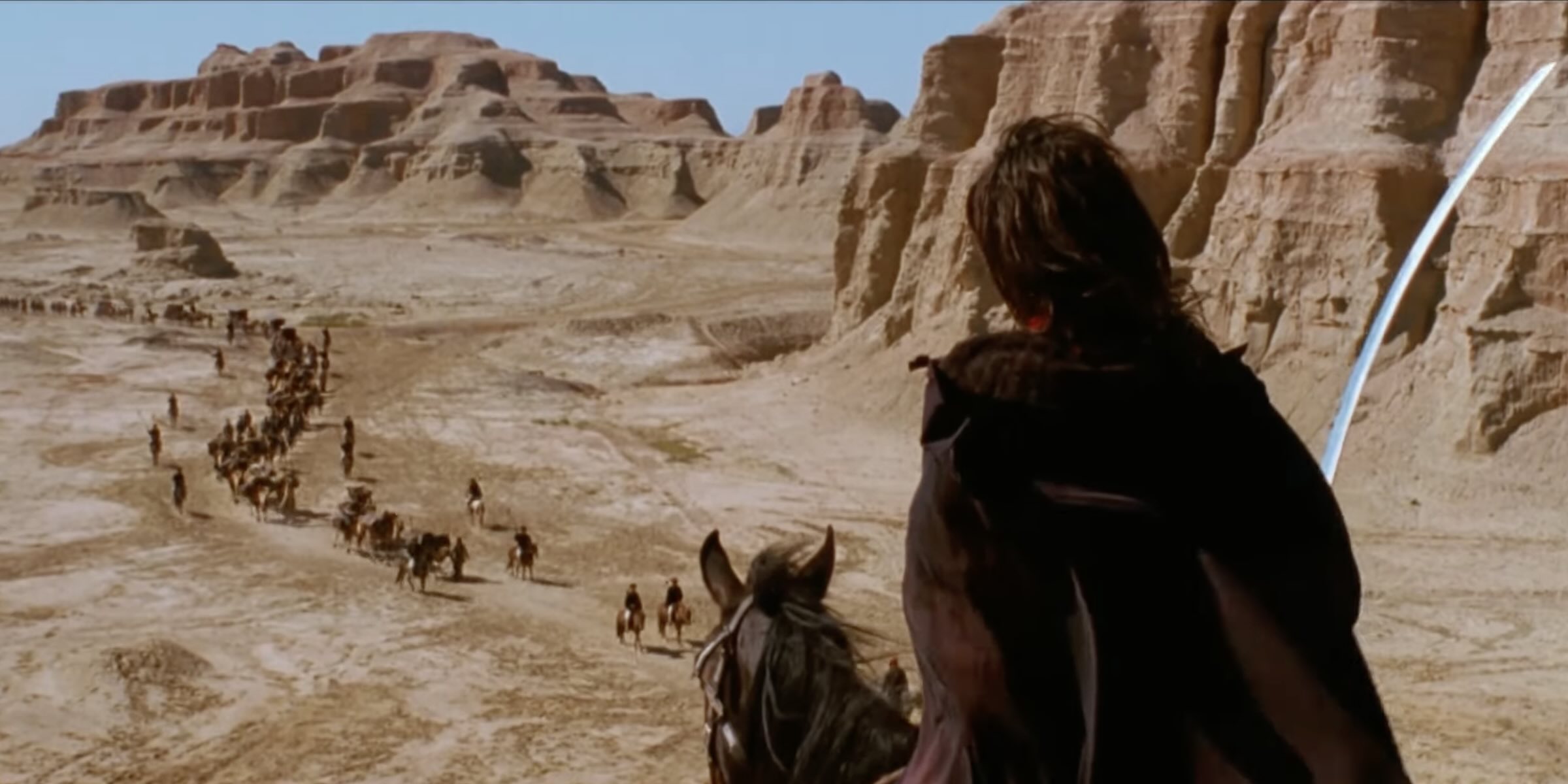 Lo and the Turkic bandits in Crouching Tiger, Hidden Dragon
Martial Arts
The martial arts are beautifully executed. The film makes impossible movement feel serious. People fly across rooftops, balance on bamboo, and defy physics, but somehow it doesn’t look ridiculous. It feels graceful. Almost natural inside the world of the movie.
I’ve done a bit of Wing Tsun, so I also enjoyed recognizing small things. The angles, the close movement, the redirection, the way trained bodies react before thought catches up. Obviously, this is not realistic fighting. But it still carries the feeling of martial discipline.
What I liked most is that the fights are not just about who is stronger. Even great warriors can be beaten by poison. Li Mu Bai is not defeated because he lacks skill. He is defeated because mastery doesn’t protect you from everything. That makes the story more interesting than a simple best fighter wins logic. The action is beautiful, but not empty. It makes the characters feel almost mythical, then reminds you they can still bleed, fail, and die.
Philosophical Depth
The movie has a clear class system: governors, warriors, servants, bandits, masters, disciples, witches, and ordinary people. That part is understandable. What’s more interesting is how each class recognizes the other through posture, speech, silence, discipline, movement. A warrior sees another warrior before the fight starts. A master sees talent before it is trained. A noble sees someone who doesn’t belong.
That’s where the film gets deeper. Everyone is bound by a role. Jen is born into privilege, but wants the freedom of warriors. Shu Lien has strength, but she is trapped by duty. Li Mu Bai has discipline, but he is still bound by obligation. Jade Fox stands outside the accepted order, which makes her dangerous.
So the question of freedom is not exactly political. Not in the John Stuart Mill sense of individual liberty. It is more personal. How free are you when your role already decides what you owe?
That part hit me. People like myself have duties and responsibilities too. Family, work, promises, reputation, people depending on you. You can want freedom, but freedom is never clean. The movie understands that. Everyone wants to escape something, but nobody escapes without cost.
A Deep Love Story
One interesting part is how heavy the love story feels. It is not fast, loud, or desperate. It carries weight because of restraint. Li Mu Bai tries to rise above desire. He walks the path of discipline, almost like someone preparing himself to become a monk. But in the end, he can’t fully do it because he loves Yu Shu Lien. That’s what makes it painful.
Their love is not childish. It is not about chasing a feeling the moment it appears. It has time behind it. Years of duty, silence, hesitation, and self-control. They respect each other so much that even their love becomes disciplined. That is almost non-existent now.
Nowadays, people meet fast, want fast, leave fast, heal fast, replace fast. But in this film, love evolves slowly. It grows under pressure. It survives because it is not always acted on. We admire that kind of love because it feels deep. But really, the world is moving in the opposite direction.
The Turkic Warrior
I don’t think this is revealed at any point, but the horse-riding gang felt like classic Turkic people to me. Maybe it was the horses, the open land, the clothes, or the way the group moved. I obviously felt some closeness to it, but I didn’t think about it much at first.
Then Lo starts singing those verses. He uses the song to comfort Jen and convince her to take a bath. The song goes something like:
...yiriliyorida, gördüm şu güzel kız havar guni, ...bu güzel ayları, ey güzel kız havalı kız...
Roughly, at least to my Turkish ear, it sounds like:
...I saw this beautiful girl... these beautiful moons/months... oh beautiful girl, cool beautiful girl...
That was somehow the best scene for me. It just hit something differently. For a moment, it felt like ancestors speaking to me through the film. Maybe that sounds strange, but that’s what it felt like.
Why Is it So Acclaimed?
I think the answer is simple. This film asks you to feel something you can't quite name. The fights are beautiful but they hurt, the love story is restrained but it aches, and the philosophy leaves explanation to the watcher. It just sits there, waiting for you to catch up.
The film actually believes what it's saying about duty, desire, and the cost of freedom, and that belief comes through in everything, from the way characters move to the way they stay silent. So maybe it's acclaimed because, for once, a film that could have been beautiful and empty chose not to be. It had the looks to coast on, and it didn't.