
“Smaller is faster” is a well-known hardware design principle, as you might already know. Smaller pieces of hardware will be faster than larger ones because shorter distances mean less latency.
I have always thought about this principle mainly in terms of computer hardware. Processors, memory, circuits. Just a while ago, however, I started to realize that this principle is also deeply applicable to software development, not just to physical machines. Throughout this post, Iʼll try to give some practical insights, brief reasoning, and a few examples showing how “smaller is faster” also applies to teams, code, and systems in software development.
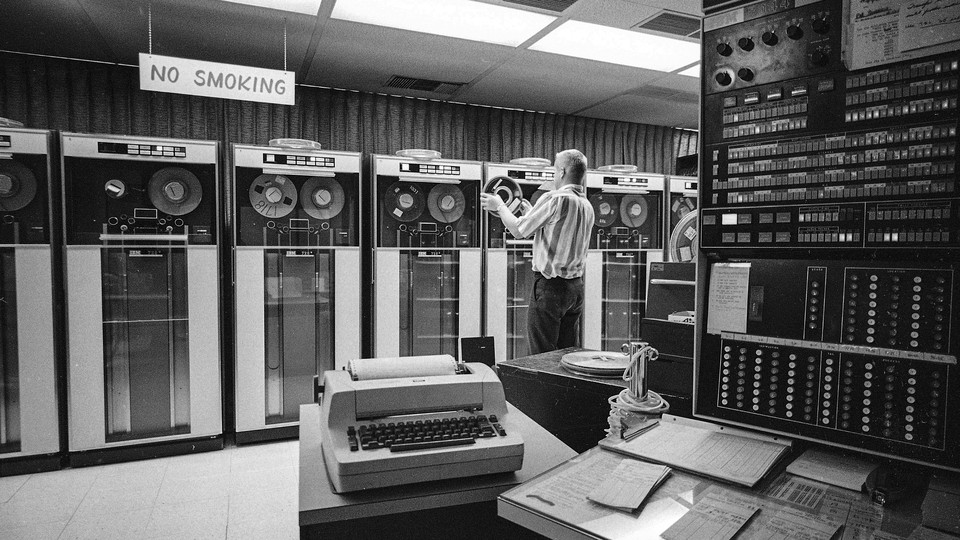 Smaller is faster
Don Lightfoot in main computing facilities changes some computer tapes at the Rand Corp. Headquarters in Santa Monica, Calif., November 1966. (AP Photo/George Brich)
Smaller Data, Faster Transfer
The amount of data needs to be transferred has been important in software development. Obviously, the smaller the data, the faster itʼs transferred.
Transferring fast is essential when it comes to web page loading. We want pages to load as fast as they can. As a result, we minify our JavaScript files. We also compress almost anything we can to make transfers as fast as possible. From images to CSS, from payloads to database dumps, we constantly aim to shrink size.
Thus, smaller data favors faster transfers. Even a few kilobytes shaved off here and there add up for users.
Smaller Code, Faster Understanding
Understanding a piece of code is an everyday activity for every programmer. Itʼs hard to focus when the code gets big. We have been trying to overcome code complexity by single responsibility principle and many others. Typically, we are trying to minimize, or in other words, make the code smaller so that we can understand it faster.
A function or method with 100 lines of code would be scary to anyone. Hence, the smaller a piece of code, the faster you can understand it. Smaller pieces also make refactoring easier and help reduce cognitive load.
Smaller Teams, Faster Progress
The team size can be one of the key factors for a successful software project. As team size grows, human communication complexities become a burden to the project. Adding more programmers to a project can make a project even worse than it was, as described in The Mythical Man-Month.
In my experience, I have always seen smaller teams produce faster. I think it isnʼt just about communication. As the team gets bigger, you also need to deal with politics and coordination overhead. In a team of three people, you canʼt really have politics. Everyone knows what needs to be done, and progress feels natural.
Consequently, the smaller the team size is, the faster you develop.
Smaller Services, Faster Deployment
In contemporary software development, microservices architecture has been widely adopted. Previously, we developed monolithic applications where a single code base contained all of an applicationʼs logic. As the project grows bigger, it becomes almost impossible to reason about the code base or manage each piece of software.
Decomposing the project into smaller parts became the natural solution. Therefore, the smaller the service you have, the faster it is to develop, test, and deploy it. Smaller services also reduce dependency risks and make ownership clearer.
All in All
"Smaller is faster" is applicable to various aspects of software development. The smaller the software is, the faster it becomes to understand, develop, deploy, and optimize it. This principle applies not only to code and systems but also to how we think and organize teams. Smaller truly is faster.