
Everyone works in AI circles. There's a specification at least half-written by AI. There's a piece of code 80% written by AI. There's a strategy document 60% written by AI. If everything is being written by AI, then there's very little thinking happening underneath it. Part of this blog has always been a discourse with other people and what came out of that. For someone to have a discourse, they need to think and listen. It feels like everyone forgot the thinking part. I fear we’re leaning on LLM nonsense so much that we’re starting to confuse whatever comes out of it with what we should do, believe, or work on.
Then I have, and I see other people having, a distaste for AI. If something has even a hint of an AI stain, we don't seem to like it. Everyone is celebrating anything hand-crafted because everyone is so fed up with AI. I don't think this problem is due to AI usage. The trouble is that AI slop started replacing the very judgment we are supposed to produce. We treat LLMs like oracles, not next-token predictors. And yet, despite all the advances, I can't seem to get AI to do anything genuinely novel. Maybe I'm not smart enough to find the right way to make it do that, but that's been my experience.
People in different positions rely on LLMs inside companies and even governments. They outsource their decisions only to find out they are actually accountable for them. A strategy document written by AI is pretty much telling the organization what it should be good at, as if we no longer trust ourselves enough to make that judgment. I don't buy that. I want to feel the depth of someone’s actual judgment. I want to know they sat with the problem, walked a bit to take a fresh air, listened to hard feedback, argued with someone over the alternatives, got a bit angry, and ultimately made the imperfect trade-offs themselves. Imperfect is actually good, because we don’t know what’s absolutely right anyway. What matters is that a person stands behind the writing.
We simply must not give away the thinking. I think we have to draw that line ourselves. If we don't, I think we'll end up in a Wall-E situation where robots do everything and eventually decide what's good for us too. We're dumbing ourselves down by choosing not to exercise the cognitive abilities we still need. We're going into autopilot instead of using AI as a copilot.
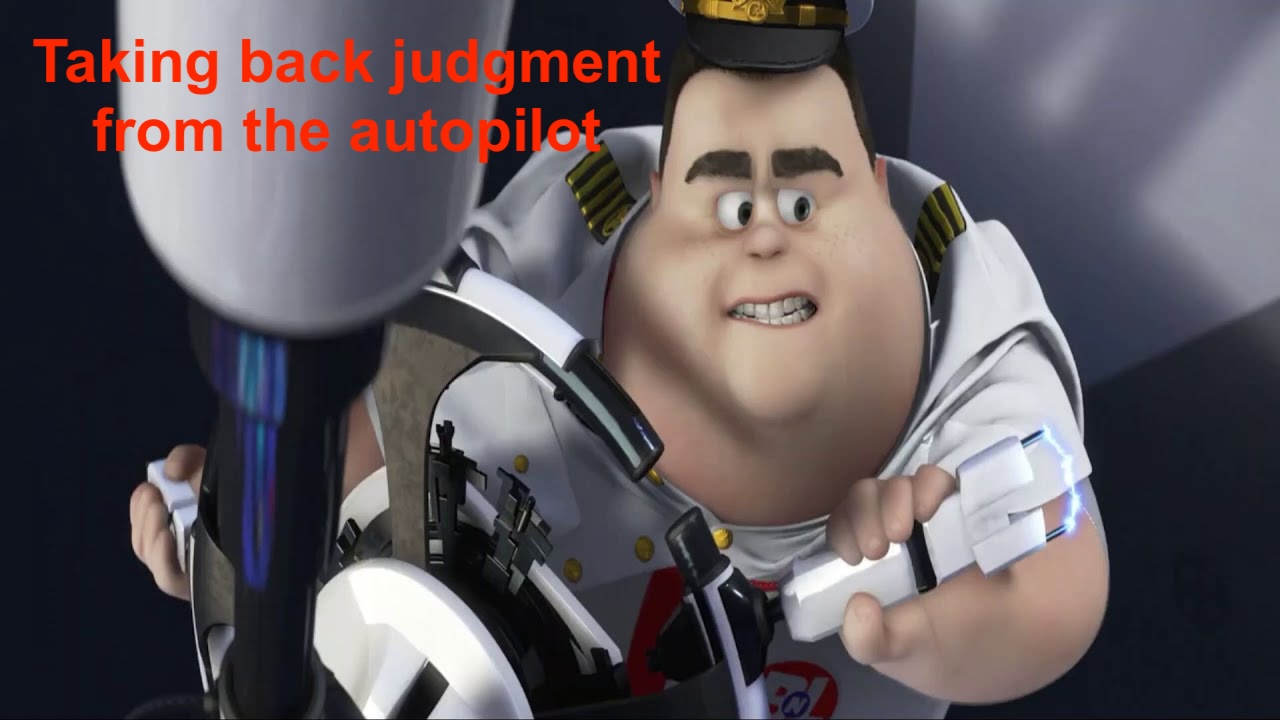 Taking back judgment from the autopilot
Even if we do the thinking, there’s still skill atrophy. Automation usually removes the steps that humans used to perform. Writing a shell script used to require combining a few commands and knowing how to use them. Automating it sounds great, and we should do that. Nevertheless, I still want to understand what’s happening underneath. Doing the work manually was part of the drill that taught me what was happening. Now some of these drills are gradually disappearing, and some of the understanding goes with them. That’s why I think not all routine work is a waste. Sometimes it’s how you build the judgment you later need. That’s also why I think taste will survive even as code gets written partially or entirely by LLMs, because taste is earned through years of routine experience.
Unfortunately, I think we're already shooting ourselves in the foot by relying on LLMs too much. I did some of it myself, experimenting with vibe coding and using it to draft similar documents. But I kept coming back to a fairly obvious conclusion. I’ve found that I get to better answers when I actually stay with the problem. When I read, try to understand it, talk it through, listen to people who disagree, get parts of it wrong, and come back to it again, I do better. These activities seem to slow me down; however, real thinking is a slow process. Friction can be excellent way to hit your head to come up with a deeper understanding. Remember going to bed with a bug giving you a headache, your brain searching every corner just to figure out where it happened? It was a long exercise that led to a few epiphanies for you. There’s no shortcut for that.
I have an even bigger fear for people who never had the chance to work without these tools long enough to develop their own judgment first. Now I ask newcomers to write down what they understood instead of just asking AI to summarize something for them. Summarizing is not understanding. A summary can be produced without anyone understanding anything. Understanding is a deeper process that can take years to develop. You read something, try to explain it, get challenged, notice what you missed, and explain it again. Eventually some of these become your own judgment. And you sometimes need to be wrong. LLMs tell you you're right every single time.
Nobody is saying we should stop using AI. I use it every day, and I’m not planning to stop. But I catch myself handing over things I should have sat with a bit longer. Letting AI help write our code is one thing. Letting it decide which code is worth writing in the first place is something else entirely. I still want those choices made by people who have argued about them, gotten them wrong, and have to live with what happens next. If we hand that over too, then nobody is thinking anymore.