
When I was a child, Rumi wasn’t a philosopher or a poet for me. He was candy. Every once in a while, a relative from Konya would visit and bring Mevlana şekeri. The rock sugar associated with Rumi. Sweet, shiny, and simple. How couldn’t I like him? For me, Rumi meant sugar, not wisdom.
 Mevlana candy with a turkish tea
As I grew older, I started noticing Rumi’s words in books, in conversations, sometimes even quoted casually by teachers. They sounded nice. Some even made sense. But that was about it. I couldn’t feel them yet.
Years later, I went to see Rumi’s resting place in Konya. Honestly, I wasn’t mature enough at the time to truly understand what he stood for. I’m still not claiming I’ve matured enough but at least now, the words feel different. So, I’d like to share a few quotes I like from him and what it feels like.
Come, come, whoever you are.
Sounds simple. When I lived in Turkey, it seemed straightforward: everyone is welcome. But only after working abroad did I truly come to appreciate it. I have been surrounded by colleagues from every culture and every background. Now I feel its weight. Each of us has our own view of the world, and with experience, that view is challenged. We cannot know everything, so we develop idiosyncrasies that help us make sense of things. Saying “whoever you are” is easy. Truly living it takes experience. I bet I wouldn’t have experienced it the same way if it wasn’t for the international atmosphere.
The one who looks for faults in others does not see his own
This one feels particularly relevant to modern life. True accountability is hard, but it makes everything easier. The blame game never works. I’ve never seen it work both personally and professionally. It doesn’t help you, and it doesn’t help the other side. In tech, we call it a blameless postmortem. Saying “We made a mistake” is powerful, because then the focus shifts to “What do we do next?”
I was raw, I was cooked, I was burned.
This line is one you can only understand with age. You can’t grasp it fully when you’re young. It takes breakups, job losses, disappointments with family and friends. Life has to hit you a bit. Only then do you see how life cooks you, burns you, transforms you.
What you seek is seeking you.
I suppose “fuck around and find out” is the modern, negative way of putting it. Life can become a self-fulfilling prophecy. The more you invest in something, the more people you meet who are also drawn to that investment. The more you work on something, the more opportunities you get to do it. I remember in school feeling that I was good at physics, but looking back, it was simply because I spent a lot of time with it. My friends were also the ones who spent time on it, and so the cycle continued. The same story repeats. So choose wisely.
I lost everything, but I found myself.
This one always reminds me of people like Mike Tyson. He had it all, then lost it all, and somehow became wiser through the wreckage. Sometimes abundance hides the self. Losing forces you to find it. Too much can actually get in the way of self-worth.
I saw many people without clothes, but they were truly human. I saw many clothes, but inside them there was no human.
Time reveals this truth. Some people stumble into riches or titles, but that does not make them genuine. And some who seem poor or humble in every way often turn out to have understood life far more deeply. You may believe this is true, but only by living through it do you truly appreciate it. You end up learning wisdom from people you never expected to.
Be as you seem, or seem as you are.
I’m still learning this one. I interpret it a little differently: if you want to become a better version of yourself, try acting that way, and over time you might grow into it. Some might see that as orthodox or even fake. To me, it’s a bridge. Practice becoming who you want to be until it feels natural.
Humans change, but the essence of human action stays true across time. Rumi wrote these words centuries ago, and yet they still land as if they were written yesterday. That, in itself, is extraordinary.
With all our technological advancements, it’s easy to believe we are progressing endlessly, becoming better in every way. And yes, in some ways we are. But in many others, I believe we are gradually degrading. The human aspect aka our ability to feel, to suffer, to love, to search for meaning remains the same. It is timeless. It is deeply personal.
Perhaps that’s why Rumi still resonates. His words remind us of what doesn’t change. They hold up a mirror to the part of us that no invention, no progress, no algorithm can replace.
For me, Rumi started as candy.
A glimpse from another time, when I mimicked a Mevlevi without yet understanding Mevlana.
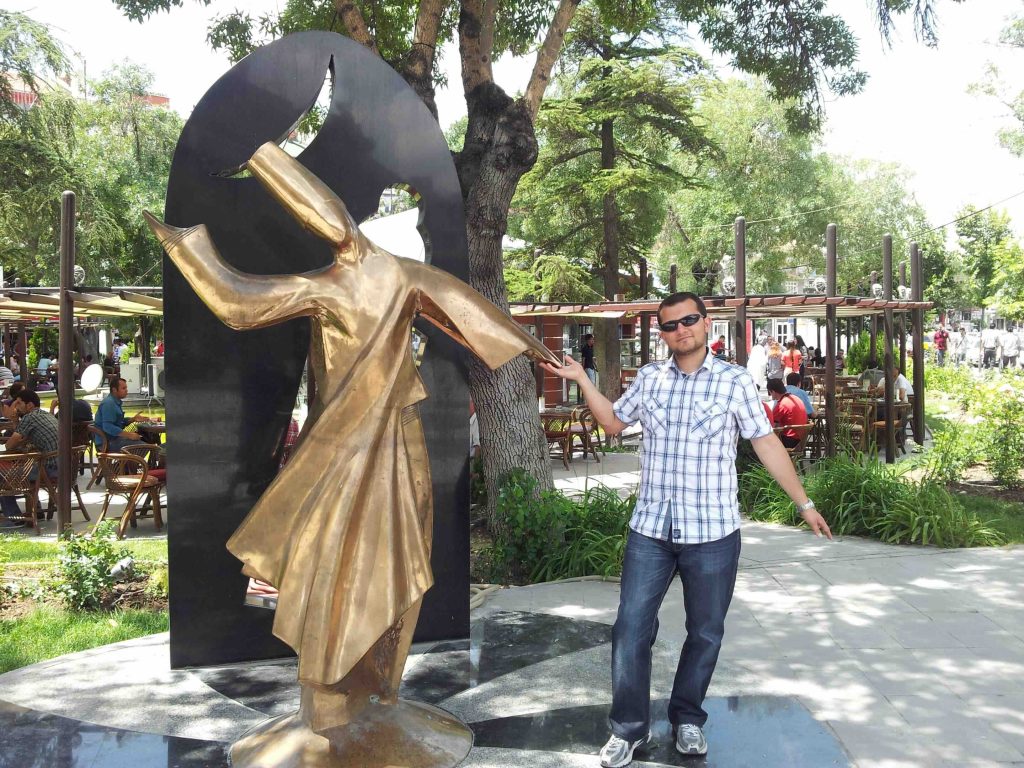 Yusuf Aytas in Konya early 2010s