Brewing Turkish Tea
I love Turkish tea. If I go too long without it, especially while traveling, I start to miss it badly. It’s an addiction I have no intention of fixing. When I talk to non-Turkish friends or colleagues about tea, they usually assume it’s the same as any other black tea. To some extent it is, but not really. Turkish tea isn’t just dropping a few leaves in hot water and waiting three minutes. It has its own rhythm, its own rules. Naturally, the next question always comes: “So, how do you make it?” I’m always happy to answer, and while I don’t claim to know better than anyone else, let’s start with the word itself.
The Word Çay
First, let’s clear up the word itself. In Turkey, we don’t say “tea”. We say çay (pronounced chai). The word is shared across cultures along the old Silk Road: chai in India, shai in Arabic, чай (chay) in Russian. They all trace back to the same origin, even if each country has its own way of brewing and drinking it.
For us, Çay is a way to show hospitality, initiate conversation, and give a break. When someone says, “Let’s have a çay,” they’re not only offering a drink, they’re offering time together.
Tee vs Çay
If you look around the world, you’ll notice the divide between countries when it comes to tea. Almost every language uses some version of either tea or chai. This goes back to how the plant traveled. Along the sea trade routes from China’s Fujian province, the word te spread west, becoming tea in English, thé in French, tee in German. Overland, along the Silk Road, the word cha took a different name, chai in India, çay in Turkey, shai in Arabic, чай (chay) in Russian. Now that we’ve covered the word, let’s move on to the brewing.
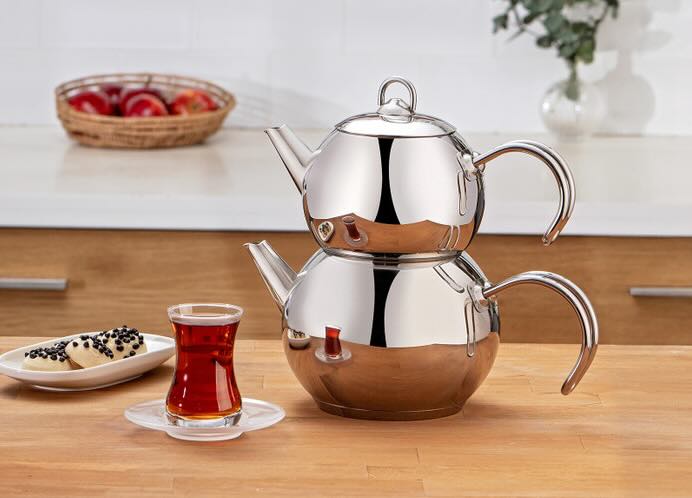
The Tools
The setup is simple, but specific. You need a Çaydanlık. It’s a two-piece kettle you’ll find in every Turkish home. The bottom holds water, the top holds tea leaves and a little water. Then, slim-waisted(ince belli or çay bardağı) glasses, because half the pleasure is seeing that deep amber glow. Sugar cubes if you like. I strongly suggest drinking it without sugar to get the best out of it, especially if you have a dessert on the side, like baklava. And Turkish tea never has milk. Please don’t do that. Or at least, do it in secret.
The Ritual
- Boil water in the bottom pot.
- Rinse the top pot with a splash of hot water, then throw it out, just enough to wake the leaves.
- Add 3-5 tablespoons of black tea into the top pot. Pour boiling water over the leaves until they’re covered.
- Place the top pot back on the bottom one. The steam does the rest. Leave it alone for about 10–15 minutes. This is where patience matters.
- To serve, pour a little of the strong brew (we call it dem) into the glass, then dilute it with hot water from the bottom pot until it’s as strong or as light as you like.
The Culture
Turkey ranks as the country with the highest tea consumption per person followed by Ireland where I live. Funny enough. It’s top for a reason. It’s what you drink for breakfast, what you drink when a guest arrives, when you’re passing time in a café, when you’re trying to think, or when you don’t want the conversation to end. You don’t really offer tea in Turkey. We always assume it’s wanted. The only question is how strong.
Even the glass matters.It keeps the tea hot at the base, cooler at the rim, so you can hold it comfortably while sipping slowly. That’s part of the design: forcing you to slow down so that you can enjoy your conversation.
The Health
I used to drink tea first thing in the morning, but I abandoned that for two good reasons. First, Turkish tea is high in caffeine. If you drink it right after waking up, it overrides your body’s natural hormones that are supposed to wake you gently. Second, tea makes it harder to absorb vitamins and minerals, which isn’t the best way to start the day.
So now I save it for the afternoon around 3 p.m., somewhere between lunch and dinner. I usually have it with a small dessert. These days, my favorite pairing is dates or figs with walnuts. Highly recommended. The sweetness, the crunch, the warmth of tea. It’s a simple pleasure I wouldn’t trade.
Black tea is full of antioxidants, which help fight free radicals and support heart health. It can also give you a steady lift in focus and energy without the crash you’d get from coffee. Many people say it helps with digestion too, which is probably why it’s such a natural after-meal drink. I personally avoid drinking it right after meals because it can block vitamin and mineral absorption as noted above. But in Turkey, refusing tea at the table is almost unthinkable. Do not do that. Many would consider it rude.
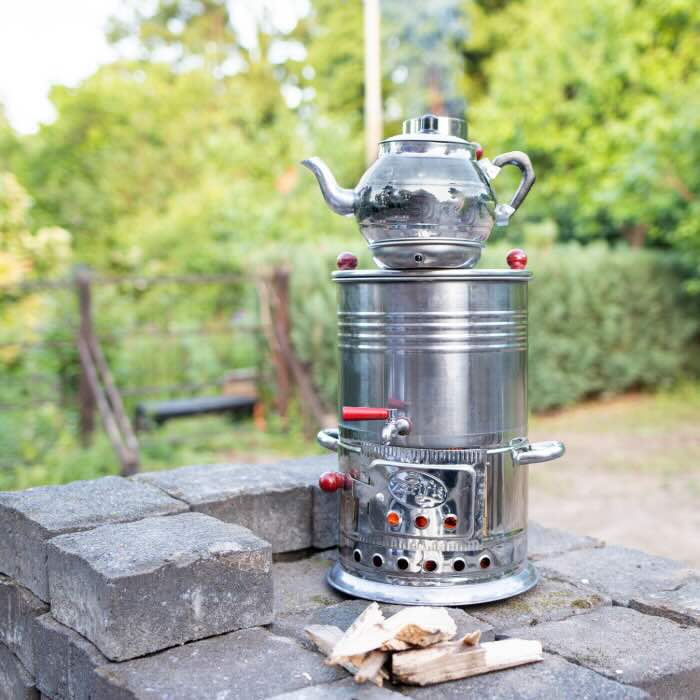
The Semaver
Most Turkish households rely on the standard çaydanlık, but there’s another way of brewing that feels almost ceremonial: the semaver.
A semaver is a larger, often ornate, tea-brewing vessel that works on the same principle. Strong tea on top, hot water below but it runs slower, gentler, and usually outdoors. Traditionally, it’s fueled by wood, though modern versions use electricity. The heat is steadier and softer, which means the tea doesn’t rush. It develops. The slower the brewing, the better the taste.
Making tea in a semaver is less about convenience and more about mood. It can take an hour or more, but that’s part of the point. You gather around it, talk, wait, add more water, stretch the moment. The tea that comes out of it is smoother simply because it’s been given time. Sometimes the wood fire leaves a trace of smoke in the tea, and that hint of earthiness takes it to another level.
I’m sipping my çay as I write this, and I hope you enjoyed reading it as much as I enjoyed sharing it.