
When I look back at the projects I’ve worked on, the most peaceful moments were always when the code felt consistent. Everything lined up. Names made sense. Files looked familiar. It felt like I could read the system instead of fighting it.
That sense of order never happens by accident. It comes from small, deliberate choices made over time. How you name things. How you format them. How you agree on what “good” looks like as a team.
Consistency is not about perfection. It is about predictability. When code is predictable, you can understand it faster and make changes with confidence. You trust the system because it behaves the way you expect.
Every team develops its own rhythm. Some follow language conventions strictly, while others adapt them to their context. What matters most is that everyone is moving in the same direction. A consistent codebase feels like it was written by one person, even when ten people worked on it.
In this post, I will walk through how consistency works in two common situations: starting fresh on a Greenfield project and inheriting a Legacy project that has already lived a few lives.
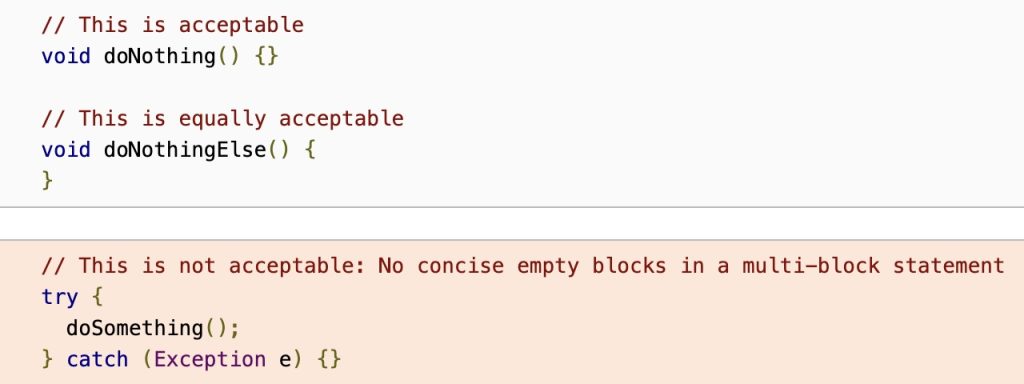 An example from Google Java Style Guide
Greenfield Project
Starting a new project is one of the few times in software development when you have full control. There is no old code to maintain, no patterns to unlearn, no half-broken conventions to follow. It is the perfect moment to set the foundation for consistency.
The best starting point is to agree on a shared style guide. Every language has its own standards, and it is much easier to adapt an existing one than to invent your own. Once the team chooses a base, you can refine it over time to match your specific needs. The goal is not to copy rules blindly, but to make sure everyone writes in the same rhythm.
Here are some well-known style guides:
- Java: Google Style Guide for Java
- JavaScript: JavaScript Style Guide
- Python: Pep 8
- C, C++: GNU Coding Standards
- PHP: PSR-2: Coding Style Guide
- C#: C# Coding Conventions
- Ruby: Ruby Styleguide
There are many other language style guides that could have been listed here but I preferred to keep my list short. The point is basing team's style guide around widely accepted style guidelines. Once a team has a base, than they can update their guidelines according to their preferences. One might use IDE support to conform to coding conventions.
Legacy Project
Most of the time, we do not get to start from scratch. We walk into systems that already have a history. Some of them are well-structured and easy to follow. Others are a mix of styles collected over years of patches, rewrites, and shortcuts. Working on legacy projects is where consistency matters the most, yet it is also where achieving it feels hardest.
The first instinct is often to clean everything up, to make it look the way we believe it should. But full rewrites rarely make sense. They cost time, break stability, and often replace one kind of inconsistency with another. Instead, it is better to start by understanding the system’s existing patterns. Every codebase has a logic of its own, even if it is not the one we would have chosen.
If the project has used a certain style consistently, keep it. For example, if a Python project uses camelCase everywhere instead of snake_case, changing it will only create noise in version history and confusion among contributors. The goal is not to make the project perfect but to make it predictable.
Here are a few small but common cases:
-
Abbreviations
Some teams write abbreviations in lowercase while others use uppercase. It is tempting to “fix” them, but consistency matters more than preference.public void getSql()Keep this format if it appears throughout the project. -
SQL Mapping
Some codebases use column indexes instead of column names. It may not be ideal, but switching halfway can create silent bugs.rs.getString(1)Follow the same pattern unless there is a clear plan to refactor it safely. -
Whitespaces and Formatting
A Python project might separate functions with one blank line instead of two. Another might indent with tabs instead of spaces. As long as it is consistent, keep it that way until a linter or formatter can enforce new rules automatically.pythondef get_user(id): pass def get_map(id): pass -
Comments and Documentation
I prefer code that speaks for itself, but sometimes you inherit a codebase where every method has a short description. Removing those comments can make diffs unreadable. Maintain the existing format until a unified documentation standard is introduced. -
Error Handling
Some legacy projects mix exceptions with return codes. For example, older Java or C systems may returnnullinstead of throwing exceptions. Rather than refactoring everything at once, handle errors using the same approach as the surrounding code and improve incrementally in new modules. -
Naming Conventions
Mixed naming styles are common. You might see bothget_user()andfetchUser(). When extending the code, match the local style. Refactor only when you can apply the change globally. -
Folder Structure and Imports
Legacy projects often grow unevenly: duplicated modules, nested folders, or circular imports. Instead of reorganizing everything at once, create new modules in the cleaner structure and move older ones gradually. -
Testing and Assertions
You might encounter projects that use bothunittestandpytest, or custom test runners with different assertion styles. The best way forward is to standardize in new code and adapt older tests slowly.
Legacy systems remind us that style is not only about code. It is also about respect. Respect for the people who built it, and for the ones who will maintain it next. The best way to improve an old project is to first make peace with how it works.
Consistency does not mean freezing things in place. It means changing them carefully, with awareness of the whole system. Once the team agrees on a clearer direction, introduce gradual improvements through pull requests, code reviews, and automation. Over time, even the most chaotic project can regain its rhythm.